Resource API v1alpha1
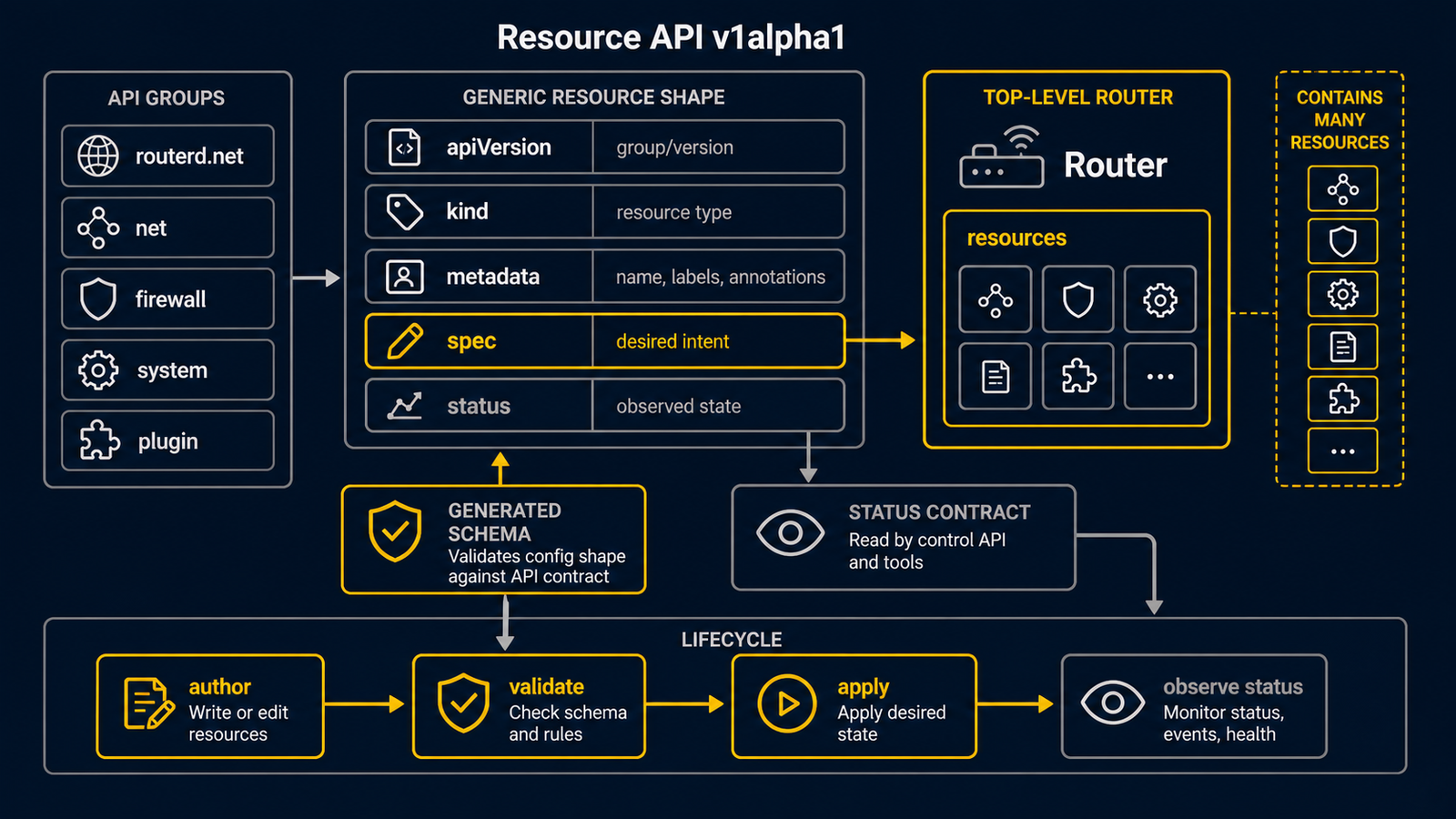
routerd configuration is a top-level Router resource with a list of typed
resources. This page summarizes the current implemented API surface.
Since Phase 1.6, DHCP names follow RFC spelling: DHCPv4* and DHCPv6*.
There are no compatibility aliases for the earlier names.
Common Shape
apiVersion: net.routerd.net/v1alpha1
kind: Interface
metadata:
  name: wan
spec:
  ifname: ens18
  adminUp: true
| Field | Meaning |
|---|---|
apiVersion | API group and version. |
kind | Resource kind. |
metadata.name | Name inside the kind. |
spec | Desired intent declared by the user. |
status | Observed state written by routerd or a managed daemon. |
API Groups
| API group | Main kinds |
|---|---|
routerd.net/v1alpha1 | Router |
net.routerd.net/v1alpha1 | interfaces, ManagementAccess, reusable IPAddressSet resources, DHCP, DNS, routes, tunnels, VIP, BGP, events, traffic flow logs |
firewall.routerd.net/v1alpha1 | FirewallZone, FirewallPolicy, FirewallRule, FirewallEventLog, ClientPolicy, PortForward, IngressService, LocalServiceRedirect |
system.routerd.net/v1alpha1 | Hostname, Sysctl, SysctlProfile, Package, NTPClient, NTPServer, LogSink, ObservabilityPipeline, RouterdCluster, LogRetention, WebConsole, ControlAPI |
observability.routerd.net/v1alpha1 | Telemetry |
plugin.routerd.net/v1alpha1 | plugin manifests |
hybrid.routerd.net/v1alpha1 | TunnelInterface, OverlayPeer, HybridRoute, CloudProviderProfile |
mobility.routerd.net/v1alpha1 | MobilityPool, SAMNodeSet, SAMRRSet, SAMEnrollmentPolicy, SAMEnrollmentClaim, SAMEnrollmentClient, SAMTransportProfile |
System Bootstrap
| Kind | Role |
|---|---|
Package | Optional narrow override for OS packages that cannot yet be derived from router resources. Normal runtime dependencies are derived automatically. |
Sysctl | Narrow escape hatch for one sysctl value that cannot yet be derived from router resources. Readback comparison can be exact or atLeast. |
SysctlProfile | Narrow escape hatch for router-oriented sysctl defaults. Normal router sysctls are derived automatically. |
Hostname | Sets the host name. |
NTPClient | Enables the OS NTP client. It can use static servers or derive servers from DHCPv4 / DHCPv6 status with public fallback servers. |
NTPServer | Runs a local LAN NTP server. Client allow ranges can be static allowCIDRs or derived with allowCIDRFrom from status fields such as IPv6DelegatedAddress/<name>.address or DHCPv6PrefixDelegation/<name>.currentPrefix. |
LogSink | Routes log events to syslog, OTLP, webhook, file, or journald sinks. |
ObservabilityPipeline | Configures OTLP environment and built-in routerd event forwarding to stdout, syslog, or Loki. |
RouterdCluster | Uses a file lease so only the leader mutates host configuration while standby nodes observe status. |
LogRetention | Manages retention for events, DNS queries, traffic flows, and firewall event logs. |
WebConsole | Enables the read-only management Web Console. |
ControlAPI | Configures the optional TCP mutation/control API listener used by local automation and SAM enrollment bootstrap. |
The TCP ControlAPI listener is disabled unless a ControlAPI resource is
declared or routerd serve --http-listen is passed. When a ControlAPI
resource enables HTTP without overriding address fields, it listens on
127.0.0.1:65432 with source admission limited to 127.0.0.1/32 and
::1/128. This is intentionally narrow as a network exposure, but it is still
the mutation/control API and it is restricted by source IP, not by Unix socket
filesystem permissions. On multi-user hosts, or where local process isolation
matters, keep the TCP listener disabled and use the Unix socket instead:
apiVersion: system.routerd.net/v1alpha1
kind: ControlAPI
metadata:
  name: local
spec:
  enabled: false
RR-side SAM enrollment over a protected private underlay can enable TCP explicitly with a narrow source allowlist:
apiVersion: system.routerd.net/v1alpha1
kind: ControlAPI
metadata:
  name: sam-enrollment
spec:
  enabled: true
  listenAddress: 10.30.0.10
  port: 65432
  allowCIDRs:
    - 10.30.0.0/24
  tokenFrom:
    file: /usr/local/etc/routerd/secrets/control-api-token
  tls:
    certFile: /usr/local/etc/routerd/secrets/rr-control-api.crt
    keyFile: /usr/local/etc/routerd/secrets/rr-control-api.key
    clientCAFile: /usr/local/etc/routerd/secrets/leaf-client-ca.pem
ControlAPI.spec.allowCIDRs rejects malformed CIDRs, 0.0.0.0/0, and ::/0.
The HTTP admission check uses the TCP remote address; forwarded headers are not
trusted for source admission. When spec.tokenFrom is set, HTTP clients must
send the token as an Authorization: Bearer <token> header. The token source
uses the common secret-source shape (file, env, and optional base64) and
is trimmed before comparison. The Unix socket control API does not use this
HTTP bearer-token check and should remain the default boundary for local
multi-user isolation. When spec.tls.certFile and spec.tls.keyFile are set,
the HTTP listener serves HTTPS. When spec.tls.clientCAFile is also set, the
listener requires and verifies client certificates signed by that CA.
Observability
| Kind | Role |
|---|---|
Telemetry | Declares an external OTLP endpoint and injects OpenTelemetry environment variables into generated service units. |
Telemetry describes routerd's own signal export endpoint for metrics, traces,
and logs emitted by managed daemons. LogSink describes log forwarding routes
for operational events and observed network logs. When a log sink uses OTLP,
prefer LogSink.spec.otlp.telemetryRef so the sink reuses a Telemetry
resource instead of duplicating collector endpoints.
Interfaces
| Kind | Role |
|---|---|
Interface | Binds a stable routerd name to an OS interface name and publishes link/address status for downstream resources. |
ManagementAccess | Declares management interfaces and apply-time lockout checks. When present, apply fails if declared interfaces are missing, blocked by firewall zoning, or an enabled WebConsole is bound to all addresses unless --allow-mgmt-lockout is set. |
PPPoESession | Defines PPPoE lower-interface settings. |
PPPoESession | Represents a routerd-pppoe-client session. |
WireGuardInterface | Represents a WireGuard interface. It can import peer definitions from SAMNodeSet, SAMEnrollmentPolicy, SAMRRSet, or an enrollment-delivered direct SAMPeerGroup with peersFrom when WireGuard encryption is selected. |
WireGuardPeer | Represents a WireGuard peer. |
TailscaleNode | Configures a local Tailscale node for exit-node and subnet-router advertisement through a managed systemd unit. |
IPsecConnection | Defines a cloud VPN oriented strongSwan connection. |
VRF | Represents a Linux VRF device and route table. |
VXLANTunnel | Represents a VXLAN tunnel. |
PPPoESession.spec.enabled: false keeps the PPPoE definition renderable but stops
routerd from starting the managed pppd unit. This is useful for a fallback path
that should remain available for manual testing without consuming a line's
PPPoE session slot during normal operation.
TailscaleNode can use authKey for one-shot bootstrap, but production
configs should prefer authKeyEnv and authKeyFile so the secret value stays
outside the YAML and the Git history. If neither is set, routerd assumes
tailscaled is already logged in and only reapplies the advertised node
options. Tailscale's default UDP/41641 port is reserved when this kind is
present, so WireGuard listen ports must use a different value. The Tailscale
how-to covers the full setup flow.
WireGuardInterface accepts privateKeyFile so the private key can stay out of
the router YAML. If the file is absent, non-dry-run apply generates it with mode
0600 and never overwrites an existing non-empty key. WireGuardPeer also
accepts presharedKeyFile for optional peer PSKs; inline key fields are
intended for examples and tests. On FreeBSD, routerd renders an rc.d service
that creates the
wg interface, loads the key from that file, applies peers, and then assigns
declared static addresses for the WireGuard interface.
WireGuardInterface.spec.peersFrom references SAMNodeSet/<name>,
SAMEnrollmentPolicy/<name>, or a fetched SAMRRSet/<name> and derives peers
from node-set WireGuard identity, accepted enrollment claims, or projected RR
node WireGuard identity. This is the WireGuard-specific materialization path only;
plain IPIP/GRE SAM transport uses SAMTransportProfile and does not require
WireGuard peers. Static WireGuardPeer resources with the same metadata.name
override generated peers.
Kernel modules and systemd-networkd/resolved adoption drop-ins are derived from
router resources. If a config still contains the removed KernelModule,
NetworkAdoption, Link, or NixOSHost kinds, routerd returns an error
instead of silently ignoring the input.
WAN Addressing and Delegation
| Kind | Role |
|---|---|
IPv4StaticAddress | Assigns a static IPv4 address. |
VirtualAddress | Declares an IPv4 /32 or IPv6 /128 VIP. spec.family is ipv4 or ipv6; mode: vrrp uses keepalived on Linux and CARP on FreeBSD. |
DHCPv4Client | DHCPv4 lease, IPv4 address, and optional default route managed by routerd-dhcpv4-client. |
DHCPv6Address | Represents DHCPv6 IA_NA intent for platform renderers. |
DHCPv6PrefixDelegation | DHCPv6-PD lease managed by routerd-dhcpv6-client. |
DHCPv6PrefixDelegationLeaseSync | Mirrors a DHCPv6PrefixDelegation client lease snapshot from an active node to standby nodes. |
DHCPv6Information | DHCPv6 information request result, including DNS, SNTP, domain search, and AFTR observations. |
IPv6DelegatedAddress | Derives a LAN-side address from a delegated prefix. |
IPv6RAAddress | Represents IPv6 addresses learned from RA/SLAAC. |
VirtualAddress.spec.gratuitousARP: true sends
arping -U -c 3 -I <interface> <address> after Linux adds or restores the
address in mode: static. The default is false, so existing command
sequences are unchanged. This option is valid only for an IPv4 static address
on Linux. FreeBSD continues to use only its ifconfig ... alias address
operation when the option is left disabled.
DHCPv6PrefixDelegation no longer selects an OS DHCPv6 client. DHCPv6-PD is
owned by routerd-dhcpv6-client. Set spec.clientDUID to a plain hex DUID when
the DHCPv6 client identity must stay fixed across HA nodes.
LAN Services
| Kind | Role |
|---|---|
DHCPv4Server | Provides a dnsmasq DHCPv4 service and optional address pool. |
DHCPv4ServerLeaseSync | Mirrors the dnsmasq lease file derived from a DHCPv4Server resource. |
DHCPv4Reservation | Reserves an IPv4 address for a MAC address. |
DHCPv4Relay | Represents dnsmasq DHCPv4 relay. |
IPv6RouterAdvertisement | Generates RA, PIO, RDNSS, DNSSL, M/O flags, MTU, preference, and lifetimes. |
RogueRADetector | Auto-derived status resource that reports non-self IPv6 Router Advertisements observed on an RA-serving interface. |
DHCPv6Server | Provides dnsmasq DHCPv6/RA service in stateless, stateful, both, or ra-only mode. |
DHCPv6ServerLeaseSync | Mirrors the dnsmasq lease file derived from a DHCPv6Server resource. |
DNSZone | Owns a local authoritative zone with manual and DHCP-derived records. |
DNSResolver | Owns a routerd-dns-resolver daemon instance, listen profiles, cache, metrics, and query logging. |
DNSForwarder | Declares one DNS match rule for a resolver. It either serves one or more DNSZone resources or forwards to named DNSUpstream resources. |
DNSUpstream | Declares one reusable upstream endpoint using udp, tcp, dot, or doh, with optional status-derived addresses, bootstrap resolvers, TLS name, and source interface. |
Android does not use DHCPv6 DNS configuration, so IPv6 LANs should publish
RDNSS through IPv6RouterAdvertisement.spec.rdnss.
dnsmasq is limited to DHCPv4, DHCPv6, relay, and RA. DNS answering and
forwarding belongs to DNSResolver.
LAN DNS suffixes can be tied to a local zone by referencing
DNSZone/<name>.zone from DHCPv4Server.spec.domainFrom,
IPv6RouterAdvertisement.spec.dnsslFrom, and
DHCPv6Server.spec.domainSearchFrom.
DNSResolver.spec.listen[].sources lists DNSForwarder names for that
listener. If the list is omitted, the listener uses every DNSForwarder that
references the resolver. DNSResolver.spec.sources is no longer accepted in
user YAML; split old inline entries into DNSForwarder and DNSUpstream.
DNSForwarder.spec.match contains domain matches such as home.example or
. for the default upstream. spec.zoneRefs serves local DNSZone resources;
spec.upstreams forwards to DNSUpstream resources. DNSSEC validation is
declared on DNSForwarder.spec.dnssecValidate.
DNSForwarder.spec.queryTimeout optionally sets a positive per-upstream query
deadline such as 1s. If omitted, ordinary queries inherit healthcheck.timeout
(default 3s). Alternatives must be listed explicitly in the same upstreams;
timeouts or upstream failures can advance to the next candidate, but valid
NXDOMAIN answers do not. Exhaustion returns uncached SERVFAIL without falling
through to another forwarder. Candidate deadlines add up; outer resolvers in a
chain need room for all inner attempts. See DNS query deadlines.
DNSUpstream.spec.protocol is udp, tcp, dot, or doh. addressFrom
can derive UDP upstream addresses from resources such as
DHCPv6Information/<name>.dnsServers. sourceInterface binds outgoing DNS
queries to a Linux interface name, and bootstrap or bootstrapFrom supply
resolver addresses for DoH or DoT endpoint name resolution.
DS-Lite, Routes, and NAT
| Kind | Role |
|---|---|
DSLiteTunnel | Creates an ip6tnl tunnel to an AFTR. The AFTR can be static IPv6, FQDN, or DHCPv6 information. |
TunnelInterface | Creates a trusted Linux or FreeBSD L3 underlay tunnel device for hybrid overlay delivery. mode supports ipip, gre, and IPIP-over-UDP fou/gue; fou/gue require encapSport and encapDport. On FreeBSD point-to-point ipip/gre, address requires the explicit IPv4 peerAddress, the inner destination; routerd never derives it from the CIDR. peerAddress is rejected on Linux, whose existing address semantics remain unchanged. |
OverlayPeer | Describes an on-prem or cloud overlay peer and the local underlay used to reach it. |
HybridRoute | Lowers non-default remote IPv4 prefixes through an OverlayPeer into managed IPv4Route resources. |
MobilityPool | Declares the CloudEdge local address/capture intent: pool prefix, federation group, BGP delivery, optional reusable cloud capture profiles, local value expansion, provider trap placement, and one local self overlay. It imports the shared topology exclusively through membersFrom. routerd derives BGP /32 advertisements and provider trap action plans from observed facts and BGP best paths. |
SAMNodeSet | Defines the shared SAM fabric identity/topology registry: node identity, site, role, placement, maintenance, Event Federation endpoint, SAM transport endpoint, and non-secret WireGuard peer identity. It is the sole MobilityPool topology source; a local pool overlay contains only local capture and discovery details. |
SAMRRSet | A runtime-only, policy-scoped enrollment snapshot returned to an admitted leaf. It contains the selected RR nodes projected from the policy's static SAMNodeSet; it cannot be declared in top-level router YAML. |
SAMEnrollmentPolicy | Hub/RR-only authorization for SAM transport enrollment claims. It binds a transport profile, the output rrSetRef, required static RR topology rrNodeSetRef, join-token source, join audience, tunnel and endpoint prefixes, optional leaf ID pattern, TTL, explicit claim revocation, optional WireGuard materialization settings, and authorized MobilityPool references or direct mobilityPrefixes used as the RR-side admission authority. directMesh.peerGroupRef can additionally authorize an opportunistic direct-leaf group; RR remains the fallback. Leaves do not declare a copy. |
SAMEnrollmentClaim | A leaf-local remote enrollment request: leaf identity, join nonce/timestamp/HMAC, remote policy/RRSet references, tunnel address, endpoint, optional signed directMesh opt-in, optional BGP identity, optional MobilityPool-owned /32s, optional WireGuard credentials, expiry, and revocation state. |
SAMEnrollmentClient | Runs leaf-side bootstrap/refresh: submits its local remote-request SAMEnrollmentClaim to bootstrap RR endpoints, fetches the allowed RRSet plus any eligible direct peer group as one topology snapshot, and persists it as dynamic state only when missing, near expiry, or claim material changes. Direct peers require every RR to attest the same client identity and topology. If every RR has accepted the claim but valid peer snapshots are still converging, directTopologyPending keeps RR forwarding and performs a GET-only recheck; it never installs a partial direct group. joinTokenFrom authenticates that identity, while token-less enrollment is trusted control-plane input. After an RR loses only volatile admission state, it re-admits automatically only from the identity-aware current-RR response; revoke, a different active identity during renewal, a malformed response, an old/mixed RR, or any uncertainty retains RR fallback. It does not require a local policy or NodeSet. |
SAMTransportProfile | Declares this router's stable selfNodeRef, mode (ipip, gre, fou, or gue), encryption (none or wireguard), inner tunnel prefix, underlay interface, BGP router, and peer sources. fou/gue use the existing TunnelInterface FOU/GUE path and require encapSport and encapDport. It reads topology and peer endpoints from SAMNodeSet, a runtime-synchronized SAMPeerGroup, SAMEnrollmentPolicy, or SAMRRSet with peersFrom; SAMNodeSet is the canonical identity/topology/endpoint source and nodeRefs can select its adjacent peers. An enrollment-delivered SAMPeerGroup with direct: true creates an opportunistic direct leaf path with higher BGP local preference; it must use pair-stable addressing and follow a non-optional SAMRRSet fallback source. A direct profile must explicitly set its normal RR bgp.importPolicy.localPreference; bgp.directLocalPreference must exceed it. When bgp.timers, bgp.timersPreset, and bgp.convergenceProfile are omitted, generated peers inherit the referenced BGPRouter defaults; profile-local values override them. SAMPeerGroup is not an authorable top-level resource. routerd derives per-peer TunnelInterface, endpoint /32 IPv4Route, and, unless spec.bgp.generatePeers: false, BGPPeer resources through a replace-on-reconcile DynamicConfigPart. |
CloudProviderProfile | Describes provider capabilities and external-command auth for declarative address capture planning. |
IPAddressSet | Defines reusable IP address sets from literal addresses and FQDNs. Linux nftables renderers materialize these as named sets for firewall, redirect, NAT, and policy-routing consumers. |
IPv4Route | Adds IPv4 routes, including DS-Lite defaults and explicit drop routes. |
ClusterNetworkRoute | Expands Kubernetes Pod and Service CIDRs into static IPv4 routes through worker next hops. |
BGPRouter | Declares a local BGP router. The current backend is a long-lived routerd-bgp GoBGP daemon with default-deny import policy. |
BGPPeer | Declares GoBGP-managed BGP peers for a BGPRouter, for example Kubernetes BGP speakers. |
BGPDynamicPeer | Declares a bounded GoBGP dynamic-neighbor accept range for hub/RR fabrics. It lets an RR accept passive BGP sessions from leaf source prefixes without pre-declaring every leaf as a BGPPeer. |
BFD | Declares one BFD session intent. On Linux and FreeBSD, routerd renders FRR bfdd configuration and records observed BFD state without deconfiguring referenced GoBGP peers. |
NAT44Rule | Performs IPv4 NAPT in the nftables routerd_nat table. |
NAT44SessionSync | Mirrors selected NAT44 conntrack sessions from an active node to standby nodes over SSH. |
PortForward | Publishes one WAN-side IPv4 TCP/UDP port to one internal IPv4 target with DNAT. |
IngressService | Publishes one WAN-side IPv4 TCP/UDP service. Multiple backends, TCP/HTTP health checks, and failover, sourceHash, or random backend selection are accepted. |
LocalServiceRedirect | Redirects LAN-origin IPv4/IPv6 traffic for IPAddressSet destinations to a local router port. This is intended for plaintext DNS/NTP interception without touching DoH or DoT ports. |
EgressRoutePolicy | Represents default-route selection, marked IPv4 policy routing, and hash-based multi-target egress routing. |
EgressRoutePolicy supports destinationSetRefs and excludeDestinationSetRefs
in addition to CIDR fields. Use them to steer or exclude FQDN-backed destination
sets without expanding addresses directly into the policy resource. Use
mode: priority for default-route failover, mode: mark for one marked route
table, and mode: hash or candidates[].targets for source/destination hash
distribution across multiple route tables.
HybridRoute is intentionally conservative in the MVP: it rejects default
routes, accepts only the main table, and lowers IPv4 destinations into the
existing IPv4Route controller path instead of installing routes directly.
CloudEdge Mobility keeps the operator-authored surface declarative:
MobilityPool is the high-level address/capture intent and SAMNodeSet is the
write-once node identity registry and shared membership source for generated
peers,
SAMEnrollmentPolicy selects static RR identity/topology through
rrNodeSetRef (required server-side to project a snapshot) and names its
fetched runtime snapshot with rrSetRef.
SAMEnrollmentPolicy is hub/RR-only while SAMEnrollmentClaim is the leaf's
remote request. SAMEnrollmentClient is the leaf bootstrap/refresh controller
that obtains that snapshot without a local policy or NodeSet;
SAMTransportProfile is the high-level
transport/BGP intent, federation events
are observed facts, and BGP best paths are the mobility ownership/delivery view.
When an RR HTTP ControlAPI requires tokenFrom, leaf
SAMEnrollmentClient.spec.controlAPITokenFrom carries the same bearer token on
claim submit and RRSet fetch requests. When the RR requires mTLS, leaf
SAMEnrollmentClient.spec.controlAPITLS supplies CA, client certificate, client
key, and optional server-name settings for those HTTP requests.
The mobility planner derives BGP /32 advertisements and provider trap action
plans; operators should not hand-author per-address paths or capture procedures
for the mobility control plane.
MobilityPool always uses BGP delivery; route-mode planning and its delivery
mode selector have been removed from the mobility mainline.
For CloudEdge Mobility, put the full shared identity, topology, placement, and
maintenance registry in SAMNodeSet, and import it with
MobilityPool.spec.membersFrom. The pool carries only its self-member overlay;
it does not repeat remote members. spec.profiles.cloudCaptures stores reusable
self-site cloud capture defaults; spec.values stores non-secret local
identifiers; capture.targetFrom and ownershipDiscovery.subnetRefFrom project
those local values into generated provider action targets and discovery scope.
Provider, capture, and discovery fields belong only to the self-member overlay.
Explicit self-member fields override profile defaults.
members[].capture.target carries non-secret provider target identifiers into
generated background provider action plans.
On-prem proxy-ARP members can set members[].ownershipDiscovery.mode: onprem-l2 with multiple sources such as dhcpv4-lease, arp-observer,
on-demand-arp, and pve-svnet. These event sources are merged into the same
routerd.client.ipv4.observed ownership facts consumed by the BGP mobility
planner, so PVE IPAM environments do not have to rely on DHCP lease visibility
alone. on-demand-arp uses source scanInterval for a low-rate proactive
prefix sweep, probing one target per interval so quiet existing clients can be
discovered without manual owner-side ARP traffic.
When the pool's EventGroup has authenticated listen and peer delivery
configured, an ARP request observed on one leaf is also published as the
short-lived fact routerd.mobility.arp.request.observed. Remote leaves in the
same group, pool, and discovery scope ask only their local on-demand-arp
observer to probe that target. The owner then publishes the ordinary
routerd.client.ipv4.observed fact and BGP /32; raw Ethernet frames are not
extended. Stable event IDs, expiry, source-node loop prevention, and the
observer's target cooldown bound duplicate work. An identity-only EventGroup
keeps the proactive sweep as the fallback. If an EventPeer.types allowlist is
used, it must include routerd.mobility.arp.request.observed for this fanout.
Passive on-prem sources are not authoritative by default. If operations accept
an empty L2 segment after the sources have been armed, set
ownershipDiscovery.allowEmptyAfter; the pool reports a non-authoritative
Complete discovery snapshot with discoveryObserved: 0 while it is fresh.
SAMNodeSet.spec.nodes[].placement groups same-provider cloud routers into
deterministic active/standby capture placement; its maintenance.drain removes
a member from active selection. All nodes in a mobility demo should receive the
same SAMNodeSet identity and placement source, while each MobilityPool keeps
only its self capture/discovery overlay, so they project the same placement
decision without repeating remote members. Provider, capture, and discovery
details on a remote member are invalid.
Selective Address Mobility does not configure firewall or NAT policy. Operators
compose firewall/NAT by referencing literal addresses in the existing firewall
and NAT resources. Provider action plans are review artifacts until they are
imported into the action journal and allowed by ProviderActionPolicy, approval,
allowlists, and an executor plugin.
routerd derives reverse path filter sysctls, tunnel MTU, RA MTU, and TCP MSS
clamping from router role, tunnel, firewall zone, and RA/DHCPv6 resources.
Configs should declare the tunnel and LAN/WAN intent rather than separate
IPv4ReversePathFilter or PathMTUPolicy resources.
For trusted overlay paths that need a non-TCP IPv4 PMTU black-hole workaround,
OverlayPeer.spec.pathMTU.forceFragmentIPv4 or
TunnelInterface.spec.pathMTU.forceFragmentIPv4 can enable a default-off Linux
nftables routerd_forcefrag table. It clears DF only for oversized IPv4 packets
on the derived forwarded path. It is supported only for wireguard, ipip,
gre, fou, and gue overlay underlays.
If an externally managed source interface has a lower MTU, such as tailscale0,
set Interface.spec.mtu; routerd uses it only for that source path instead of
lowering unrelated LAN paths.
ClusterNetworkRoute is a helper for Kubernetes nodes that need static routes
for Pod CIDRs and Service CIDRs instead of dynamic routing. routerd expands each
CIDR and each spec.via[] next hop into managed IPv4StaticRoute resources.
Equal weight values produce equal route metrics for ECMP-capable platforms;
different weights become different metrics so higher-weight next hops are
preferred and lower-weight next hops act as fallback routes.
EgressRoutePolicy supports excludeDestinationCIDRs. Use it to keep LAN,
management, HGW LAN, and RFC 1918 destinations out of policy routing.
FirewallRule supports destinationSetRefs and excludeDestinationSetRefs
in addition to destination CIDR narrowing. Use these fields to accept, drop, or
reject traffic for reusable FQDN-backed sets without expanding addresses into
each rule. Stateful rule expressions also support sourcePorts,
destinationPorts, ICMP / ICMPv6 type matching, rateLimit, and connLimit.
port remains accepted as a single destination port shorthand; new examples
prefer destinationPorts.
NAT44Rule supports simple source NAT with outboundInterface,
sourceCIDRs, and translation, and policy-aware NAT with type,
egressInterface or egressPolicyRef, and sourceRanges. It also supports
destinationCIDRs, destinationSetRefs, excludeDestinationCIDRs, and
excludeDestinationSetRefs. This allows internet traffic to be masqueraded
while private routed destinations or reusable address sets stay un-NATed.
NAT44SessionSync uses conntrack --dump -o extended for selected SNAT
addresses and restores the parsed tuple and conntrack mark on standby targets.
It also supports mode: event-stream, which starts with a snapshot resync and
then consumes local conntrack -E -o extended events for incremental batches.
It is intended for active-to-standby HA sync and is usually gated with
spec.when. mode: conntrackd instead runs bidirectional continuous
replication and must not use spec.when. On Linux it requires an explicit,
runtime, non-optional Sysctl resource declaring
net.netfilter.nf_conntrack_tcp_be_liberal=1; routerctl doctor nat verifies
the live value.
BGPRouter, BGPPeer, and BGPDynamicPeer currently use the long-lived
routerd-bgp daemon.
routerd maps the resource specs directly to typed GoBGP API objects over a
local gRPC Unix socket and observes status through ListPeer and ListPath;
it does not render FRR text config, run frr-reload.py, parse vtysh, or use
GoBGP's file configuration format. apply renders host artifacts only
and reports BGP as serve-managed. routerctl get BGPRouter summarizes routers,
peers, message counters, route selection state, and last errors from stored
GoBGP observation.
Prefix status includes best, valid, installed, stale, nextHop, and
observed communities. Learned IPv4 best paths that match
spec.importPolicy.allowedPrefixes are installed into the kernel FIB with
routerd-owned protocol and metric values. By default, GoBGP import policy
rewrites accepted eBGP next-hops to the learning peer address
(spec.importPolicy.nextHopRewrite: peer-address), matching the former FRR
set ip next-hop peer-address behavior so Kubernetes edge routes install as
peer-address ECMP even when the advertised next-hop is a downstream speaker.
Set nextHopRewrite: unchanged only when the advertised next-hop is meant to
be installed directly. Equal best paths for the same prefix are installed as
ECMP next hops.
BGPDynamicPeer is an RR-side BGP acceptor for GoBGP dynamic neighbors. Its
spec.listen.sourcePrefixes controls which source addresses may open BGP TCP
sessions. It is not route admission; accepted NLRI is still constrained by
spec.importPolicy.allowedPrefixes, and exported routes by
spec.exportPolicy.allowedPrefixes. BGPDynamicPeer does not carry WireGuard
public keys, allowed IPs, SAM tunnel addresses, leaf identity, TTL/revocation,
or MobilityPool ownership authorization.
SAMNodeSet and SAMEnrollmentPolicy are static hub/RR control-plane inputs
for dynamic hub/leaf fabrics. A policy's required rrNodeSetRef selects its
RR nodes, while its rrSetRef names the runtime-only SAMRRSet projected for
an admitted leaf. A leaf holds only its remote SAMEnrollmentClaim and
SAMEnrollmentClient, not a copied policy or NodeSet. The primary
private-underlay path
uses SAMTransportProfile.spec.peersFrom to consume that fetched SAMRRSet or
accepted enrollment claims and generate existing TunnelInterface and
BGPPeer resources. On an RR that accepts sessions through BGPDynamicPeer,
set SAMTransportProfile.spec.bgp.generatePeers: false so SAM creates transport
tunnels without generated per-leaf BGP peers. Enrollment can be authenticated
with a policy
joinTokenFrom and claim joinNonce, joinTimestamp, and joinHMAC fields.
When the referenced secret is readable at validation time, joinHMAC is
verified as lowercase hex HMAC-SHA256 over the canonical claim join payload:
policy/RRSet refs, leaf ID, audience, nonce, timestamp, tunnel address,
endpoint, direct-mesh opt-in, owned /32s, BGP identity, and optional WireGuard credentials.
If encryption: wireguard is selected, a hub can also set
WireGuardInterface.spec.peersFrom: [{resource: SAMEnrollmentPolicy/<name>}];
routerd then materializes WireGuardPeer entries only for non-revoked,
non-expired claims whose leaf ID and tunnel address satisfy the policy and that
carry WireGuard credentials. The claim's spec.mobility.ownedAddresses are
authorization input for MobilityPool ownership and must fall within a pool
referenced by the policy when that policy is present in the same config. BGP
route admission remains a BGPDynamicPeer/BGP policy concern.
Use routerctl doctor sam-enrollment-client on leaves to verify claim
references, bootstrap endpoint/token configuration, enrollment controller
status, and fetched RRSet dynamic-state freshness. Use routerctl doctor bgp-dynamic-peer on RRs to verify dynamic peer discovery and route-admission
counters.
routerctl mobility leaf-config can generate the minimal automatic-enrollment
leaf config for this shape. It emits local leaf resources plus
SAMEnrollmentClient, supports HTTP bearer token and mTLS fields, and leaves
SAMRRSet delivery to the enrollment fetch/dynamic-state path instead of
embedding static RR inventory in the generated leaf YAML. Add
--direct-peer-group <name> only for policy-approved leaves that should try a
direct path; the generated RRSet source remains first and is never removed.
--owned-address is optional: when omitted, the generator writes no local
service address and no BGP export/redistribution prefix, so a joining direct
leaf can establish transport without inventing a mobility /32.
BGPRouter.spec.convergenceProfile: fast is intended for Kubernetes/edge
routers that prefer quick convergence over graceful restart stale-path
retention: it derives fast peer timers and disables graceful restart unless
spec.gracefulRestart.enabled is explicitly set. Import policy is default
deny; add spec.importPolicy.allowedPrefixes for Kubernetes LoadBalancer pools.
BGPPeer.spec.ebgpMultihop enables non-direct eBGP sessions such as loopback
peering or lab-to-production validation across routed hops. Omit it or set 0
or 1 for the direct eBGP default; set a value from 2 to 255 to configure
the GoBGP multihop TTL for that peer group.
BGPRouter can use a router ID that differs from the TCP source address, but
peer routers must still configure the address that the host actually uses as
its BGP source. Check ip route get <peer-address> on Linux when the LAN has
multiple addresses, and prefer a router ID that matches that operational source
unless there is a clear reason not to.
BGPRouter can advertise connected and static IPv4 routes with independent
allowedPrefixes; only prefixes explicitly listed in
BGPRouter.spec.exportPolicy.allowedPrefixes or the redistribute allow-lists
are added to GoBGP as local paths. BGP community policy can be declared on the
router or peer with communities.send, communities.accept, and
communities.set.in/out; observed route communities are stored in status when
GoBGP reports them. The watcher defaults to a 15 second controller interval and
4096 observed prefixes, and BGPRouter.spec.watcher can tune pollInterval,
maxPrefixes, and peerStateChangeThrottle; validation rejects intervals below
3 seconds and prefix caps of 1,000,000 or more. The GoBGP MVP supports one
BGPRouter per router and does not yet support spec.vrf; unsupported
multi-router or VRF resources are reported as Pending instead of being silently
ignored. BFD resources are applied through the Linux FRR bfdd bridge and
their observed status gates the referenced GoBGP peers. spec.listen.address
and spec.listen.port bind the routerd-bgp GoBGP listener.
VirtualAddress uses keepalived on Linux and CARP on FreeBSD for
mode: vrrp. spec.family: ipv4 requires an IPv4 /32, and
spec.family: ipv6 requires an IPv6 /128. IPv6 VIPs render keepalived VRRPv3 with
family inet6; FreeBSD renders inet6 CARP aliases. Linux VRRP uses explicit
unicast peers and defaults to
nopreempt; FreeBSD CARP uses multicast advertisements on the parent interface,
so spec.vrrp.peers is ignored there. Set spec.vrrp.preempt: true only when
automatic failback is intended. Advertisement and failback timing use routerd
profile defaults rather than per-resource low-level timing fields.
The resource status records the rendered backend, VIP address, VRID, base
priority, track-adjusted priority, and generated config path when a file-backed
backend is used. track lowers priority when referenced resources such as
BGPRouter, BGPPeer, or IngressService are not healthy. Track entries use
hysteresis: by default three consecutive unhealthy observations are required to
apply a penalty and two consecutive healthy observations are required to clear
it. spec.hostname can publish VIPs into matching DNSResolver-served DNSZone
records; IPv4 VIPs create A records and IPv6 VIPs create AAAA records. Set
spec.externalDNS: true when the name is owned by an outside DNS system; routerd
will keep validating the hostname syntax but will not try to publish it or warn
about missing DNSZone coverage. routerctl get VirtualAddress shows role, priority,
peers, and transition age. NixOS remains groundwork until a native
service-manager module owns the same host artifacts.
On Linux IPv4 VRRP, spec.vrrp.gracefulActivation separates election from VIP
publication. keepalived first invokes the role hook, which commits replicated
conntrack state, raises the shared WAN/LAN VMAC identities, solicits IPv6 RA,
and records the elected role. routerd then evaluates readyWhen against
resource status. It adds the IPv4 /32 and sends gratuitous ARP only after all
conditions match. A BACKUP, FAULT, or STOP transition removes the VIP before
RA withdrawal, VMAC shutdown, and conntrack demotion. timeout defaults to 45
seconds; expiry reports activationState: Failed while keeping the VIP
withheld, and later status changes remain eligible to complete activation.
Once published on the current MASTER, the VIP remains present if readiness
temporarily degrades; status reports ReadinessDegraded and the unmet conditions.
Readiness gates initial publication, not continued ownership. Role demotion
still withdraws the VIP; this gate does not implement health-driven election.
Retention requires saved successful MASTER publication for the same address
and interface (vipPublicationConfirmed). Observation errors remain visible in
activationState/activationReason but do not erase this history. Confirmed
demotion, address absence, or failed publication invalidates it. An existing address without that publication history still goes
through the initial readiness gate.
This feature is opt-in; VRRP resources without gracefulActivation retain
keepalived-managed VIP behavior.
VRRP production tuning
Use preempt: true only for control-plane VIPs where automatic failback is
worth the operational sensitivity. For home-router or DS-Lite/LAN service VIPs,
prefer the default non-preemptive behavior so the backup keeps the VIP until it
fails or is intentionally moved. See examples/vrrp-tuning-presets.yaml
for complete resource fragments.
BGPPeer.spec.password is passed to the GoBGP peer as the TCP MD5
authentication password. Prefer BGPPeer.spec.passwordFrom for production
configs so the routerd YAML does not contain the shared secret.
passwordFrom.file reads a local root-owned secret file and passwordFrom.env
reads an environment variable; base64: true decodes either source before
applying it to the long-lived BGP daemon.
VirtualAddress.spec.vrrp.authentication is rendered into keepalived as
auth_pass and into FreeBSD CARP as pass. Prefer
VirtualAddress.spec.vrrp.authenticationFrom for production configs.
authenticationFrom.file reads a local secret file and authenticationFrom.env
reads an environment variable; base64: true decodes either source before
rendering. Treat rendered keepalived config and host interface state as secrets. VRRP
authentication is deprecated in VRRPv3 (RFC 5798); routerd assumes L2 isolation
and recommends using authentication only when it is still required by the
surrounding network policy or to guard against simple misconfiguration.
PortForward and IngressService render DNAT on Linux nftables and FreeBSD pf.
Set spec.hairpin.enabled: true with spec.hairpin.interfaces to also allow
LAN clients to reach the service through the WAN address. Hairpin mode requires
listen.address or listen.addressFrom; routerd renders the LAN-side DNAT plus
the return-path masquerade/NAT reflection rule. listen.addressFrom and backend
addressFrom can reference statically rendered address resources such as
IPv4StaticAddress/<name>.address or VirtualAddress/<name>.address.
IngressService treats omitted spec.hairpin.mode as auto: when the listen
address and the selected backend are on a prefix declared for the same listen
interface, routerd automatically emits the same-interface return-path SNAT
needed for LAN clients to use the VIP. If no listen-interface prefix is
declared in YAML, auto mode also treats private IPv4 listen/backend addresses
in the same /24 as hairpin-required, which covers live ISO deployments where
the interface address is inherited from the boot environment. Set
spec.hairpin.mode: off to suppress that behavior, or manual with
interfaces for explicit NAT reflection.
IngressService accepts multiple backends, TCP/HTTP health checks, and
failover, sourceHash, or random backend selection. The runtime controller
resolves backend FQDNs, falls back to the previous resolved IPv4 address when DNS
temporarily fails, records backend health in status, and writes either one
active backend or a healthy backend distribution. When only one backend remains
healthy, sourceHash and random degrade to failover. Linux nftables rendering
uses the status-selected backend set on the next NAT reconcile and emits
jhash ip saddr for sourceHash or numgen random for random. Existing
conntrack entries are not flushed, so established flows can stay on the old
backend while new flows use the selected backend. Validator checks reject
listen-port collisions between IngressService, LocalServiceRedirect, and
routerd-managed local daemons on the same protocol/interface. spec.hostname
can also publish the listen address into matching DNSResolver-served DNSZone
records. Set spec.externalDNS: true when AD DNS or another external DNS system
owns the name. routerctl get IngressService shows active backend,
per-backend health, hairpinMode, whether hairpin is required, and whether the
expected nftables SNAT rule is present or missing. Inspect host ip, nft, and
conntrack state directly when debugging live dataplane behavior.
Ingress, NAT-like resources, DS-Lite, IPv6 PD/RA, and routing resources derive
the runtime sysctls they need, including forwarding, redirect suppression,
reverse-path-filter exceptions, and per-interface RA acceptance. routerd apply plans and renders those derived settings but mutates the host only
for explicit Sysctl / SysctlProfile escape hatches; routerd serve applies
the derived runtime settings during controller reconcile. During
maintenance, routerctl ingress drain ingress/<service> backend=<name> --duration 10m marks a backend as drained in the runtime state store. The
controller treats it as unhealthy with reason Drained until the duration
expires or routerctl ingress undrain ingress/<service> backend=<name> clears the
state.
IPAddressSet writes literal IPv4/IPv6 addresses into nftables named sets when
the ruleset is rendered. FQDN A/AAAA records are resolved by the runtime
controller, which refreshes referenced nftables sets in place without reloading
the whole firewall, NAT, or policy table. The next refresh is scheduled at half of the
observed minimum DNS TTL, but never sooner than 60 seconds. refreshInterval
can cap that delay when a set should be refreshed more aggressively.
Entries in IPAddressSet.spec.names are exact DNS names only. microsoft.com
means the A/AAAA records for microsoft.com itself; it does not include
www.microsoft.com, login.microsoft.com, *.microsoft.com, or deeper
subdomains. Wildcard and suffix-style service matching needs a DNS-observation
or provider endpoint-feed resource rather than plain FQDN resolution.
LocalServiceRedirect renders Linux nftables redirect rules in prerouting
only. It matches packets arriving from one declared interface and an
IPAddressSet destination. Router-originated traffic and health checks do not
traverse this hook.
Example:
apiVersion: firewall.routerd.net/v1alpha1
kind: PortForward
metadata:
  name: web-admin
spec:
  listen:
    interface: wan
    addressFrom:
      resource: IPv4StaticAddress/wan-ip
      field: address
    protocol: tcp
    port: 8443
  target:
    address: 172.18.1.88
    port: 443
  hairpin:
    enabled: true
    mode: manual
    interfaces:
      - lan
Coordination
| Kind | Role |
|---|---|
HealthCheck | Measures reachability through routerd-healthcheck or the development embedded runner. |
EgressRoutePolicy | Selects the highest-weight ready egress candidate. Candidates can include gateway fields and health checks. |
EventGroup | Declares one CloudEdge Event Federation bus identity. It can derive push peers from SAMNodeSet with peersFrom, while static EventPeer resources remain available as overrides. |
EventPeer | Declares a static Event Federation push peer for bootstrap or explicit override use. |
EventSubscription | Consumes matched federation events and invokes a plugin that emits a DynamicConfigPart. |
EventRule | Evaluates event streams with all_of, any_of, sequence, window, absence, throttle, debounce, and count. |
DerivedEvent | Emits virtual events derived from multiple resource states. |
SelfAddressPolicy | Selects a self address for protocols that need one. |
HealthCheck.spec.enabled: false renders the daemon unit but disables and stops it.
EgressRoutePolicy candidates also accept enabled: false; disabled
candidates are not selected even if their last observed health status is still
Healthy. In mode: priority, candidate weight remains the first selection
key, priority is the tie-breaker and policy-rule priority, and stale
ledger-owned policy-route rules/tables are removed when candidates are removed.
spec.when
Resources that support spec.when are included only when the predicate matches
routerd's local state store. The existing single-predicate form remains valid:
when:
  state:
    wan.ipv6.mode:
      equals: pd-ready
Use all for AND and any for OR. They can be nested to any depth:
when:
  any:
    - all:
        - state:
            dslite.a.health:
              status: set
        - state:
            wan.ipv6.mode:
              in: [pd-ready, address-only]
    - state:
        pppoe.health:
          equals: healthy
Each when node must be exactly one of state, all, or any. state maps
state variable names to exists, equals, in, contains, status, and
for matches. One-element all is equivalent to the single-predicate form.
State-management resources are not exposed as config kinds; express conditional
activation directly on the dependent resources with spec.when.
HealthCheck declares probe intent: target, protocol, cadence, and thresholds.
When a health check is referenced by an EgressRoutePolicy candidate or target,
routerd derives the health-check daemon, source binding, and socket mark from
that route target automatically. Platform-specific socket mechanics stay inside
the controller and renderer.
Removing the route target's health-check reference also removes that derived
binding. A standalone check without sourceInterface, sourceAddress, via,
or fwmark follows the host's normal routing, which may use the management
network. To continue monitoring a specific path independently of route
selection, declare its binding explicitly on HealthCheck; removing a
reference does not preserve the previous path.
Daemon status snapshots replace the health check's current route observations,
including clearing fields that the latest probe no longer reports. Historical
events retain their network.* attributes; those old attributes must not be
interpreted as the route of the current probe.
WebConsole.spec.listenAddressFrom derives the HTTP listener address from
another resource status, for example Interface/mgmt.status.ipv4Addresses.
Use it instead of a literal listenAddress when the management address comes
from DHCP, IPAM, or another declarative resource.
Status Provides Contract
Fields such as addressFrom, gatewayFrom, dnsServerFrom, and
dependsOn[].field can reference only fields that the
target kind declares in this contract. The validator rejects missing resources
and fields outside the target kind's provides set.
| Kind | Provides |
|---|---|
BFD | peer (string), phase (string) |
BGPDynamicPeer | acceptedRouteCount (int), discoveredPeerCount (int), discoveredPeers (objectList), observedAt (timestamp), peerGroup (string), phase (string), rejectedRouteCount (int), rejectedRouteSummary (object), sourcePrefixCount (int), sourcePrefixes (stringList) |
BGPPeer | acceptedPrefixes (int), address (string), observedAt (timestamp), phase (string), state (string) |
BGPRouter | acceptedPrefixes (int), establishedPeers (int), observedAt (timestamp), peers (objectList), phase (string), prefixes (int) |
Bridge | ifname (string), members (stringList), phase (string) |
ClientPolicy | phase (string) |
ClusterNetworkRoute | phase (string), pods (stringList), services (stringList) |
DHCPv4Client | currentAddress (string), defaultGateway (string), device (string), dnsServers (stringList), domain (string), expiresAt (timestamp), gateway (string), interface (string), leaseTime (int), ntpServers (stringList), phase (string), rebindAt (timestamp), renewAt (timestamp) |
DHCPv4Relay | phase (string) |
DHCPv4Reservation | address (string), hostname (string), phase (string) |
DHCPv4Server | configPath (string), dnsServers (stringList), domain (string), dryRun (bool), interface (string), ntpServers (stringList), phase (string) |
DHCPv4ServerLeaseSync | command (string), dryRun (bool), phase (string), sourceCount (int), sources (objectList), syncedAt (timestamp), targetCount (int), targets (objectList) |
DHCPv6Address | address (string), interface (string), phase (string) |
DHCPv6Information | aftrName (string), dnsServers (stringList), domainSearch (stringList), phase (string), sntpServers (stringList), source (string) |
DHCPv6PrefixDelegation | aftrName (string), currentPrefix (string), dnsServers (stringList), domainSearch (stringList), interface (string), phase (string), sntpServers (stringList) |
DHCPv6PrefixDelegationLeaseSync | command (string), dryRun (bool), phase (string), sourceCount (int), sources (objectList), syncedAt (timestamp), targetCount (int), targets (objectList) |
DHCPv6Server | configPath (string), dnsServers (stringList), dryRun (bool), interface (string), phase (string), sntpServers (stringList) |
DHCPv6ServerLeaseSync | command (string), dryRun (bool), phase (string), sourceCount (int), sources (objectList), syncedAt (timestamp), targetCount (int), targets (objectList) |
DNSForwarder | phase (string), resolver (string), upstreams (stringList) |
DNSResolver | listenAddresses (stringList), listeners (int), phase (string), sources (int), updatedAt (timestamp) |
DNSUpstream | address (string), phase (string), url (string) |
DNSZone | pendingRecords (objectList), phase (string), records (int), updatedAt (timestamp), zone (string) |
DSLiteTunnel | aftrIPv6 (string), aftrName (string), device (string), dryRun (bool), innerLocalIPv4 (string), innerRemoteIPv4 (string), interface (string), localIPv6 (string), localInterface (string), mtu (int), phase (string), tunnelName (string) |
CloudProviderProfile | capabilities (stringList), phase (string), provider (string) |
DerivedEvent | phase (string), topic (string) |
EgressRoutePolicy | advisory (bool), candidates (objectList), datapathFallbackBehavior (string), datapathReady (bool), datapathReadyAt (timestamp), datapathReadyDuration (string), datapathReadyDurationMillis (int), datapathRole (string), datapathRoleResource (string), datapathRoleTransitionAt (timestamp), datapathState (string), dryRun (bool), family (string), lastTransitionAt (timestamp), newFlowBehavior (string), phase (string), role (string), selectedCandidate (string), selectedDevice (string), selectedGateway (string), selectedGatewaySource (string), selectedInterface (string), selectedMetric (int), selectedRouteTable (int), selectedSource (string), selectedTargets (int), selectedWeight (int), updatedAt (timestamp) |
EventGroup | group (string), listenAddress (string), listenPort (int), nodeName (string), peers (int), peersFrom (objectList), pendingSources (stringList), phase (string) |
EventRule | phase (string), topic (string) |
FirewallEventLog | path (string), phase (string), sinks (stringList) |
FirewallPolicy | phase (string) |
FirewallRule | action (string), phase (string) |
FirewallZone | interfaces (stringList), phase (string) |
HealthCheck | consecutiveFailed (int), lastCheckedAt (timestamp), phase (string), protocol (string), role (string), sourceAddress (string), sourceInterface (string), target (string) |
Hostname | hostname (string), phase (string) |
HybridRoute | defaultRouteUntouched (bool), estimatedMTU (int), peerRef (string), phase (string), routes (objectList) |
IPAddressSet | addresses (stringList), ipv4Addresses (stringList), ipv6Addresses (stringList), phase (string), updatedAt (timestamp) |
IPsecConnection | phase (string) |
IPv4Route | destination (string), device (string), dryRun (bool), gateway (string), metric (int), phase (string), type (string) |
IPv4StaticAddress | address (string), dryRun (bool), ifname (string), interface (string), phase (string) |
IPv4StaticRoute | destination (string), gateway (string), interface (string), phase (string) |
IPv6DelegatedAddress | address (string), dryRun (bool), interface (string), phase (string), prefixSource (string) |
IPv6RAAddress | address (string), interface (string), phase (string) |
IPv6RouterAdvertisement | configPath (string), dryRun (bool), interface (string), phase (string), prefix (string), rdnss (stringList) |
RogueRADetector | interface (string), observedRouters (string), packetsSeen (string), phase (string), rogueCount (string), selfMAC (string) |
IPv6StaticRoute | destination (string), gateway (string), interface (string), phase (string) |
IngressService | activeBackend (object), activeBackends (objectList), backends (objectList), dryRun (bool), healthyBackends (int), hostname (string), listenAddress (string), observedAt (timestamp), phase (string), totalBackends (int) |
Interface | addresses (stringList), ifname (string), ipv4Addresses (stringList), ipv6Addresses (stringList), macAddress (string), phase (string) |
Inventory | host (object), phase (string) |
LocalServiceRedirect | phase (string) |
LogRetention | phase (string), targets (objectList), updatedAt (timestamp) |
LogSink | phase (string), type (string) |
ManagementAccess | interfaces (stringList), phase (string) |
MobilityPool | generatedBGPPaths (int), groupRef (string), ownershipResolverControlPlaneOwnerTable (objectList), pendingSources (stringList), phase (string), placementActive (bool), placementActiveNode (string), placementGroup (string), prefix (string), providerActionError (string), providerActionFailedAddresses (stringList), providerActionPhase (string), providerObservationPendingAddresses (stringList), reason (string), resolvedMemberCount (int) |
SAMNodeSet | nodeCount (int) |
SAMEnrollmentClaim | endpoint (string), expiresAt (timestamp), leafID (string), phase (string), revoked (bool), rrSetRef (string), tunnelAddress (string) |
SAMEnrollmentClient | backoff (string), claimRef (string), directTopologyPending (bool), failureCount (int), lastAttempt (timestamp), lastSuccess (timestamp), nextAttempt (timestamp), observedDirectPeerGroup (string), observedRRSet (string), phase (string), reason (string) |
SAMEnrollmentPolicy | acceptedClaims (int), leafIDs (stringList), phase (string), skippedClaims (int) |
NAT44Rule | dryRun (bool), egressInterface (string), phase (string), snatAddress (string) |
NAT44SessionSync | deleteFailed (int), deleteMissing (int), deleteOK (int), dryRun (bool), insertExisting (int), insertFailed (int), insertOK (int), lastBatchAt (timestamp), lastBatchEvents (int), lastEventAt (timestamp), lastResyncAt (timestamp), mode (string), phase (string), pruneCandidateCount (int), pruneFailed (int), pruneMissing (int), pruneOK (int), queuedEventCount (int), remoteSessionCount (int), resyncCount (int), sessionCount (int), snatAddresses (stringList), streamState (string), syncedAt (timestamp), targetCount (int), targets (objectList) |
NTPClient | phase (string), servers (stringList), source (string), updatedAt (timestamp) |
NTPServer | allowCIDRs (stringList), listenAddresses (stringList), phase (string), servers (stringList), source (string), updatedAt (timestamp) |
ObservabilityPipeline | phase (string), signals (stringList) |
OverlayPeer | nodeID (string), phase (string), role (string), underlayInterface (string), underlayType (string) |
TunnelInterface | dryRun (bool), encapDport (int), encapSport (int), ifname (string), interface (string), local (string), mode (string), mtu (int), observedAddress (string), observedPeerAddress (string), peerAddress (string), phase (string), remote (string), ttl (int) |
PPPoESession | connectedAt (timestamp), currentAddress (string), device (string), dnsServers (stringList), dryRun (bool), gateway (string), interface (string), peerAddress (string), phase (string) |
Package | dryRun (bool), packages (stringList), phase (string) |
PortForward | dryRun (bool), listenAddress (string), phase (string), target (object) |
RouterdCluster | leader (string), leaseExpiresAt (timestamp), phase (string) |
SelfAddressPolicy | address (string), phase (string), source (string) |
SAMTransportProfile | peersFrom (objectList), pendingSources (stringList), phase (string), reason (string) |
Sysctl | dryRun (bool), key (string), phase (string), value (string) |
SysctlProfile | dryRun (bool), phase (string), profile (string) |
TailscaleNode | advertiseRoutes (stringList), peerCount (int), phase (string), tailnetName (string) |
Telemetry | phase (string), signals (stringList) |
TrafficFlowLog | path (string), phase (string), sinks (stringList) |
VRF | ifname (string), members (stringList), phase (string), routeTable (int) |
VXLANSegment | ifname (string), phase (string), vni (int) |
VXLANTunnel | ifname (string), phase (string), vni (int) |
VirtualAddress | activationReason (string), activationStartedAt (timestamp), activationState (string), activationWaitingFor (stringList), address (string), dryRun (bool), hostname (string), ifname (string), phase (string), priority (int), role (string), vipAdvertised (bool), vipPublicationConfirmed (bool), virtualRouterID (int) |
WebConsole | listenAddress (string), phase (string), port (int) |
WireGuardInterface | fwmark (int), hostFirewall (object), listenPort (int), peerCount (int), peersFrom (objectList), pendingSources (stringList), phase (string), publicKey (string), selfNodeRef (string) |
WireGuardPeer | handshakeAgeSeconds (int), latestEndpoint (string), latestHandshake (timestamp), phase (string), transferRxBytes (int), transferTxBytes (int) |
Firewall
| Kind | Role |
|---|---|
FirewallZone | Assigns interfaces to zones with untrust, trust, and mgmt roles. |
FirewallPolicy | Represents global firewall behavior such as deny logging. |
FirewallRule | Represents exceptions that cannot be expressed by the role matrix. Supports source CIDRs, destination CIDRs, and IPAddressSet destination refs. |
ClientPolicy | Classifies clients by MAC address for guest isolation on Linux nftables. |
PortForward | Adds a single-target ingress DNAT rule and, when routerd manages the firewall table, an internal forward accept rule. Optional hairpin mode adds LAN-side DNAT and return-path SNAT. |
IngressService | Adds the same ingress DNAT path as PortForward; multiple backends, failover / sourceHash / random selection, and health-check intent are accepted, with runtime backend state handled by the controller path. Optional hairpin mode matches PortForward. |
LocalServiceRedirect | Adds local service redirect rules for IPAddressSet destinations. The firewall renderer opens the matching local input ports for the source zone. |
Stateful filtering renders into the nftables inet routerd_filter table.
Established traffic, loopback, and required ICMPv6 are always accepted.
routerd derives internal openings needed by DHCP, DNS, DS-Lite, and related
managed resources.
ClientPolicy supports mode: include for "listed MAC addresses are guests"
and mode: exclude for "listed MAC addresses are trusted, everything else on
the interface is guest." spec.macs is the short form for guest/trusted MAC
lists. classification[] is the structured form; each entry has
mode: trusted|guest|isolated and a match selector with macs,
ouiPrefixes, hostnamePatterns, or dhcpFingerprints. Match fields are ORed.
ipv4Reservation can keep address-based rendering stable on platforms that
cannot match Ethernet source addresses. spec.isolation can express the common
guest shape: internet allowed, LAN and management denied, and mDNS/SSDP/NetBIOS
discovery blocked. The FreeBSD pf renderer reports this resource as unsupported
because pf does not provide the
same MAC-based routed filtering model.
Management plane
ManagementAccess declares the interfaces and admin source CIDRs that
routerd must keep reachable so a non-dry-run apply cannot accidentally
lock the operator out. When at least one ManagementAccess is present, the
apply preflight runs the checks below and fails the apply unless
--allow-mgmt-lockout is set. validate, plan, and show are not
affected, and dry-run apply only reports the findings without blocking.
apiVersion: net.routerd.net/v1alpha1
kind: ManagementAccess
metadata:
  name: home-mgmt
spec:
  interfaces: [mgmt0]
  allowSourceCIDRs:
    - 192.168.100.0/24
    - fd00:100::/64
  requireWebConsoleBound: true  # default
Preflight checks:
| Check | Failure condition |
|---|---|
| Interface exists | A declared interfaces[] member is not present as an Interface resource (the management interface is being removed or renamed). |
| Firewall self-access | The firewall is enabled (at least one FirewallZone resource exists), but a declared management interface is not a member of a FirewallZone with role mgmt or trust — the input chain's policy drop would block SSH to the router. |
| WebConsole binding | WebConsole is enabled and binds to 0.0.0.0 / ::. With requireWebConsoleBound: true (default) this is a fail; otherwise a warn. |
The same checks are surfaced by routerctl doctor mgmt, which never
applies anything.
spec.allowSourceCIDRs is informational today (recorded in status and
shown by doctor) and is not yet enforced by the firewall guard.
--allow-mgmt-lockout is an emergency override, intended for the case
where you must apply a config that would otherwise be blocked and have a
console-side recovery path lined up (e.g. migrating the management
interface to a new VLAN with PVE console access ready). It is not a
default-operations flag; routine apply should not need it.
Renamed Kinds
Phase 1.6 renamed DHCP resources.
| Old | Current |
|---|---|
IPv4DHCPServer | DHCPv4Server |
IPv4DHCPReservation | DHCPv4Reservation |
IPv4DHCPScope | DHCPv4Server |
IPv6DHCPAddress | DHCPv6Address |
IPv6PrefixDelegation | DHCPv6PrefixDelegation |
IPv6DHCPServer / IPv6DHCPv6Server | DHCPv6Server |
IPv6DHCPScope | DHCPv6Server |
DHCPRelay | DHCPv4Relay |
The daemon binaries are routerd-dhcpv4-client and routerd-dhcpv6-client.