Control API v1alpha1
ConnectionTable status.bySNAT maps translated IPv4 addresses to local SNAT entry counts (total, tcp, udp, other), computed before the entry limit. An empty object means no SNAT entries; an omitted field means unavailable/unsupported (including PF). Counts do not describe provider AFTR state or port-allocation capacity.
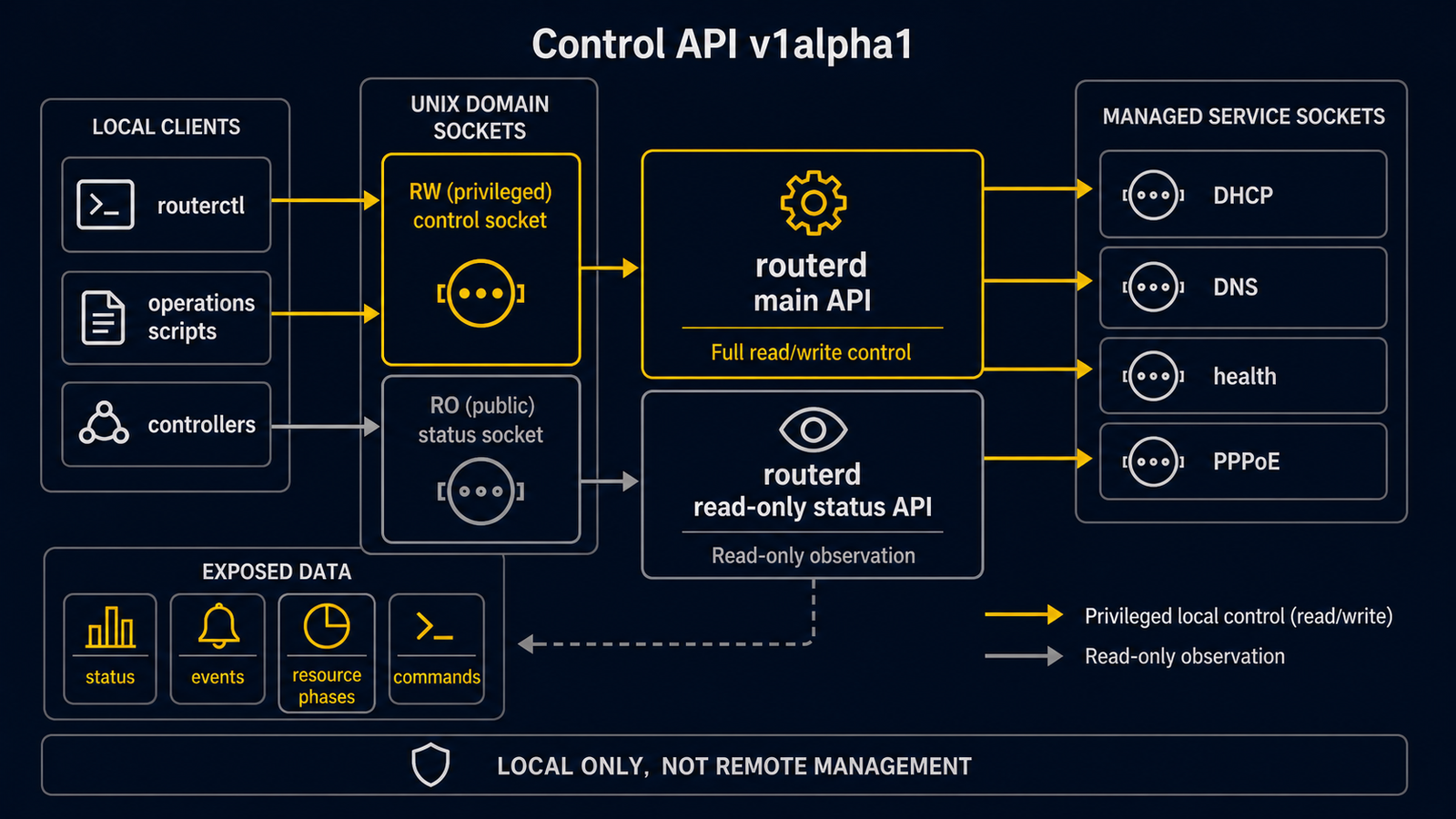
routerd and its managed daemons expose a local HTTP+JSON API over Unix domain sockets. The API is not for remote management — it is the channel through which routerctl, the routerd controllers themselves, and operations scripts on the same host read state.
routerd main process
routerd serve listens on:
/run/routerd/routerd.sock
/run/routerd/routerd-status.sock
The main control socket is intended for privileged local clients and exposes mutating endpoints such as apply and delete. The read-only status socket exposes only status-style endpoints and is safe for regular users to query.
Read endpoints on the main control socket expose status, events, and resource state. Highlights:
| Method and path | Purpose |
|---|---|
GET /api/control.routerd.net/v1alpha1/status | routerd's own status |
GET /api/control.routerd.net/v1alpha1/connections | live connections from conntrack or pf state |
GET /api/control.routerd.net/v1alpha1/dns-queries | DNS query history |
GET /api/control.routerd.net/v1alpha1/traffic-flows | traffic flow history |
GET /api/control.routerd.net/v1alpha1/firewall-logs | firewall log entries |
POST /api/control.routerd.net/v1alpha1/dhcp-lease-event | local dnsmasq lease-hook event |
SAM enrollment endpoints
Dynamic SAM enrollment uses the same API handler, but an RR exposes these endpoints only through the explicitly configured authenticated listener or privileged local socket described by the enrollment runbook. They are not a general remote-management API.
| Method and path | Purpose |
|---|---|
POST /api/control.routerd.net/v1alpha1/sam-enrollment-claims | Admit one leaf's client-authored enrollment claim. |
POST /api/control.routerd.net/v1alpha1/sam-enrollment-claims/{name}/revoke | Revoke an accepted claim; use it for deliberate operator action, not recovery. |
GET /api/control.routerd.net/v1alpha1/sam-enrollment-topologies/{name}?claim=...&claimDigest=...&claimIdentityDigest=... | Fetch the named RRSet and, only when it is attested, the optional direct peer group. |
claimIdentityDigest is a hash of only client-authored claim material. With a
joinTokenFrom policy, that material is authenticated by the join HMAC; without
one, the deployment is a trusted control-plane boundary. A current RR uses the
digest to distinguish an explicit revoke, an empty clean-boot admission store,
and a different active identity. SAMEnrollmentClient treats identity-aware
absence as permission to re-submit its current direct claim only after every
bootstrap RR has been checked. A different active identity is replaceable only
for initial admission or a local claim change, never a periodic renewal. A
missing digest, an old/mixed RR, a revoke, or any request failure must keep the
RR-only fallback; callers should use the client/controller rather than
interpreting these responses themselves.
DHCP lease hook
POST /api/control.routerd.net/v1alpha1/dhcp-lease-event is a privileged,
local hook endpoint for dnsmasq lease changes; it is not a remote-management or
general-purpose event API. routerd-dhcp-event-relay runs once for each
dnsmasq callback and normalizes dnsmasq's raw callback verbs before posting the
event.
Direct callers must send only the canonical action values added, renewed,
or removed. The raw dnsmasq verbs add, old, and del are accepted only at
the relay boundary. ip is required; mac, hostname, and interface are
optional. interface is the value reported by dnsmasq for the lease hook; raw
environment variables are never forwarded through this API.
Each accepted action publishes one exact event topic:
| Action | Topic |
|---|---|
added | routerd.dhcp.lease.added |
renewed | routerd.dhcp.lease.renewed |
removed | routerd.dhcp.lease.removed |
Controller status
Status.status.controllers and the Controllers endpoint include both the
configured controller mode and runtime reconcile state. Runtime fields include
interval, lastTrigger, lastReconcileTime, nextReconcileTime,
reconcileCount, reconcileErrorCount, consecutiveErrorCount,
currentError, lastDuration, maxDuration, averageDuration, lastError,
lastErrorTime, and lastErrorClearedAt. reconcileErrorCount is cumulative;
use currentError and consecutiveErrorCount to decide whether the controller
is failing now. These fields are observational; clients should tolerate them
being absent before a controller has run.
Managed daemons
Stateful daemons each have their own socket:
/run/routerd/dhcpv6-client/wan-pd.sock
/run/routerd/dhcpv4-client/wan.sock
/run/routerd/pppoe-client/wan-pppoe.sock
/run/routerd/healthcheck/internet.sock
On FreeBSD, the equivalent path is /var/run/routerd/....
Common daemon endpoints
| Method and path | Purpose |
|---|---|
GET /v1/healthz | Liveness check |
GET /v1/status | Daemon status and related resource state |
GET /v1/events | Event log; supports since, wait, topic query parameters |
POST /v1/commands/reload | Re-read configuration |
POST /v1/commands/renew | Daemon-specific active operation (DHCPv6 Renew, DHCPv4 lease refresh, immediate health probe, etc.) |
POST /v1/commands/stop | Graceful shutdown |
The semantics of renew differ per daemon: DHCPv6 sends a Renew, DHCPv4 refreshes the lease, healthcheck triggers an immediate probe.
The ARP observer accepts probe-target through POST /v1/commands. After a
successful command, GET /v1/status includes observed.lastCommandProbe as JSON
text with sequence, target, startedAt, completedAt, and packetsSent.
The sequence equals the same snapshot's commandProbeCount; timestamps use UTC
RFC3339. Only the last success is retained. Rejections, cooldown suppression,
partial failures, and autonomous probes do not replace it. Bind this diagnostic
to the observer process and packet capture when correlating requests; it is not
a request identifier or durable history. See the design.
Phase vocabulary
ResourceStatus.phase uses a shared vocabulary across resources:
| Phase | Meaning |
|---|---|
Pending | Waiting for required input |
Bound | A lease (DHCP, etc.) is held |
Applied | Host-side state has been applied |
Up | A tunnel or link is up |
Installed | Routes or configuration files are installed |
Healthy | Health check meets its success threshold |
Unhealthy | Health check meets its failure threshold |
Error | An operation failed |
Each phase carries a conditions array. Decisions in client code should be based on phase and conditions, not on log strings.
Events
Events have a topic and attributes:
{
  "topic": "routerd.dhcpv6.client.prefix.renewed",
  "attributes": {
    "resource.kind": "DHCPv6PrefixDelegation",
    "resource.name": "wan-pd"
  }
}
routerd persists events into SQLite. Managed daemons additionally keep them in their own events.jsonl files. EventRule and DerivedEvent consume this stream to emit virtual events.