Hybrid cloud edge design
routerd's CloudEdge direction is to let one declarative router model cover the local edge and selected cloud-side facts without letting cloud automation edit the human-managed router file. The current implementation includes dynamic configuration, plugin I/O, BGP-mode selective address mobility, generated SAM transport resources, and gated provider-action execution.
CloudEdge has two declarative pillars in this MVP:
- L3 hybrid routing, where
HybridRoutelowers remote IPv4 prefixes through anOverlayPeer. - Selective Address Mobility, where selected
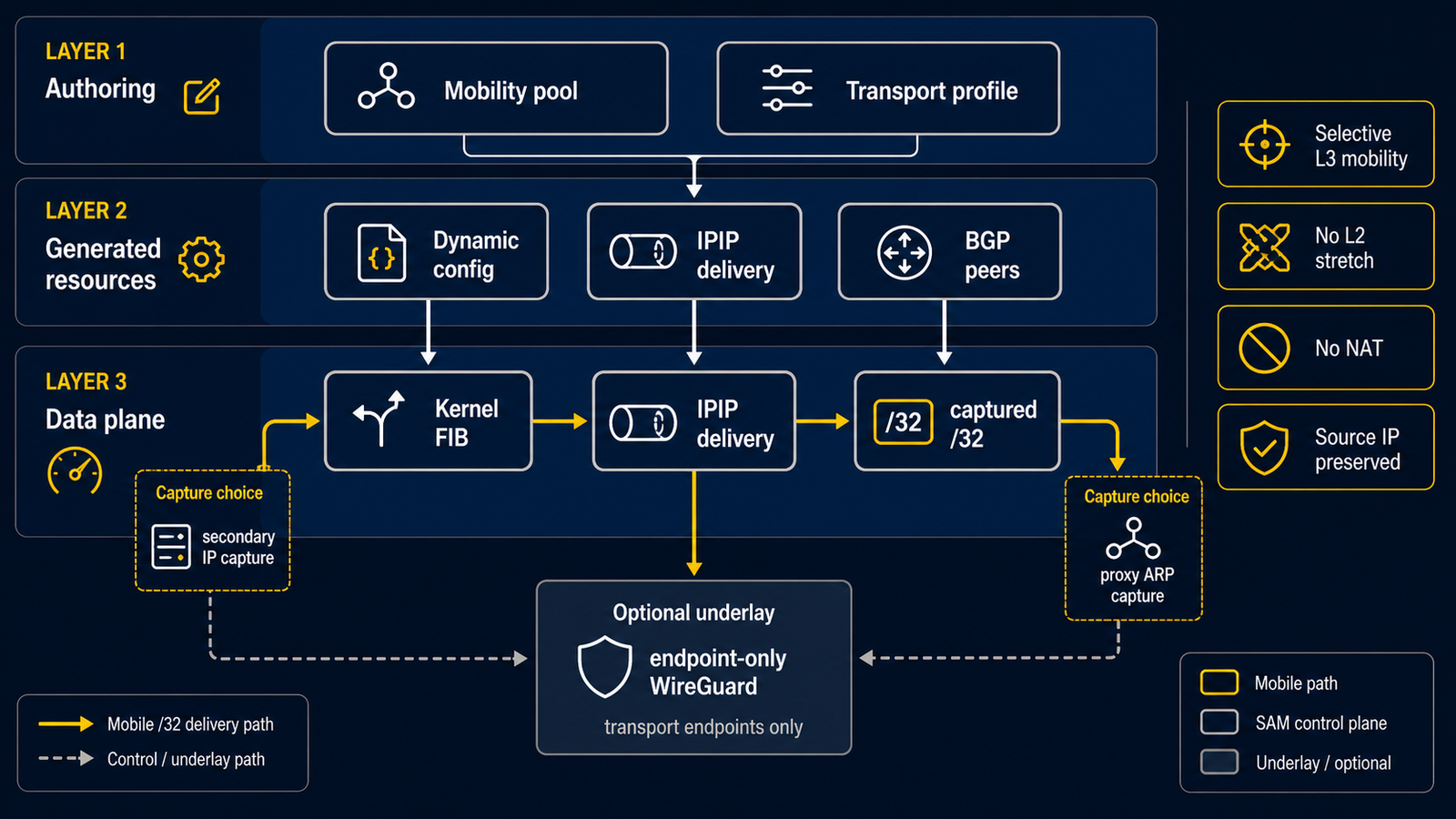
/32IPv4 addresses are captured locally and delivered to the owning side over a routerd-to-routerd overlay without stretching L2.
The model extends the existing routerd architecture in
Architecture overview: controllers still reconcile one desired
configuration, resources still use the same apiVersion, kind,
metadata.name, spec, and status shape, and the state database remains the
runtime record for generated state.
Goals
CloudEdge is aimed at mixed cloud and on-prem deployments where a router needs runtime intent from a trusted local source:
- cloud inventory that changes faster than the startup YAML should change
- selective address claims, route hints, or VPN attachment observations
- provider actions that should be visible during plan/dry-run before operators decide whether to import and execute provider-side changes through the gated executor path
- selective suppression of static fallback resources while a dynamic cloud resource is healthy
The posture is conservative. Dynamic input can contribute resources and mask
directives to the effective configuration, but it cannot mutate the startup
file. Provider action execution is a separate, default-off journaled path with
explicit policy gates.
Config layers
CloudEdge introduces three explicit configuration layers.
startup-config
The startup-config is the human-managed YAML loaded from the normal routerd
configuration path, usually /usr/local/etc/routerd/router.yaml. Operators
should keep it in git, review it like source code, and apply it through the
existing validate, plan, dry-run, and apply flow.
Plugins must never edit startup-config. A plugin can observe the startup hash and emit dynamic intent, but it cannot rewrite, reorder, or remove resources in the source file. Static fallback routes, emergency management access, and other operator-owned safety resources belong here.
dynamic-config
Dynamic-config is runtime intent produced by trusted local sources. In the MVP the primary source is a local plugin installed under the platform plugin directory, for example:
/usr/local/libexec/routerd/plugins/<name>/
Each plugin result is validated and stored as a DynamicConfigPart in the
state database. A part has a source, generation, observedAt timestamp, expiresAt
timestamp, digest, and resources/directives. Plugins return a TTL in their
PluginResult; routerd resolves that duration into the stored expiresAt for
the part. Expired parts are ignored when deriving effective-config.
Dynamic-config is not host state and is not an imperative command queue. It is runtime desired intent that participates in the same resource model as the startup configuration.
effective-config
Effective-config is the only reconcile target:
effective-config = startup-config + active dynamic parts - active masks
Controllers, renderers, dry-run, plan, status, and future CloudEdge surfaces should reason about effective-config. Startup resources suppressed by active masks are not deleted from the startup file; they are omitted from the active reconcile set and reported as suppressed with enough metadata to explain why.
Design principles
- Startup-config is immutable from routerd plugins. Operators own it.
- Dynamic-config is runtime intent, not a direct OS mutation path.
- Effective-config is the only reconcile target.
- Dynamic resources never overwrite startup resources in place.
- Masks suppress matching startup resources; they do not delete them.
- Every dynamic change must be explainable by source, generation, digest, observed time, expiry time, and directive reason.
- Plugin output is always validated before it becomes dynamic-config.
- Provider action plans are inert inside dynamic-config. They can be imported
into the action journal and executed only through explicit
ProviderActionPolicy, approval, allowlist, and executor-plugin gates.
Current scope
The CloudEdge foundation now includes:
DynamicConfigPart/DynamicOverridePolicyfor runtime intent and masks.- Trusted local plugin execution for observation, dynamic resources, provider action proposals, and executor plugins.
MobilityPoolas the primary selective-address mobility intent.SAMTransportProfileas the primary transport authoring surface. It generates IPIP/GRETunnelInterface, endpoint/32IPv4Route, andBGPPeerresources through dynamic config.- BGP-mode SAM delivery: owners advertise selected IPv4
/32paths, non-owners import best paths into the local FIB, and multipath is preserved where BGP supplies multiple next hops. - Linux SAM capture for provider-secondary-IP and proxy-ARP cases, including on-prem VRRP/single-router gating, GARP on active transition, and conservative on-demand ARP discovery.
- Provider action execution as an experimental, default-off path. Action plans remain review artifacts until imported and gated by policy, approval, and an executor plugin that holds provider credentials outside routerd core.
Still out of scope:
- remote plugin install or a public plugin registry
- consensus-based global ownership or split-brain prevention
- treating CloudEdge SAM as full L2 extension
- automatic rollback of arbitrary provider or OS mutations
L3 hybrid routing
HybridRoute is the conservative L3 pillar. It represents non-default remote
IPv4 prefixes that should be lowered through an OverlayPeer. The lowering and
status path is intentionally explicit: default routes are rejected, and
operators can review the generated route intent through the normal routerctl plan
and dry-run flow.
Selective Address Mobility
Selective Address Mobility is the second CloudEdge pillar. It is not full L2
extension. Public cloud fabrics do not expose an operator-controlled Ethernet
segment, and provider address ownership models differ. routerd therefore models
only selected mobile /32 IPv4 addresses.
The current primary authoring model is:
SAMNodeSetdeclares shared member identity, site/role, placement, and transport endpoints once for the fabric.MobilityPooldeclares the mobility prefix, federation group, local capture policy, provider trap placement, and BGP delivery. It imports topology fromSAMNodeSetand carries only the local self overlay.SAMTransportProfiledeclares the router-to-router transport: self node, inner prefix, IPIP/GRE mode, optional WireGuard encryption underlay, BGP router, and NodeSet-selected peers.CloudProviderProfiledescribes provider capabilities and external auth shape.ProviderActionPolicycontrols whether imported provider action plans may be handed to an executor plugin.
Selective Address Mobility lives in the ordinary switching/forwarding plane and
contains no firewall or NAT concept. Source and destination transparency is
intrinsic, not a configurable field. Operators compose firewall and NAT policy
separately by referencing literal addresses in existing FirewallZone,
FirewallRule, or NAT44Rule resources.
See Cloud SAM internals for the resource model and provider capability framing.
Cloud inventory and provider actions
Cloud inventory plugins can observe provider state and return dynamic resources
without mutating the provider. Provider capture planners can also emit
actionPlans such as assign-secondary-ip,
unassign-secondary-ip, ensure-forwarding-enabled, or
ensure-forwarding-disabled.
An actionPlan is not merged into effective-config and is not executed by the
dynamic-config controller. It is persisted as reviewable state. Operators may
import it into the provider-action journal and then run routerctl action
commands. Live mutation is still default-off and requires all hard gates:
ProviderActionPolicy.enabled, not dryRunOnly, approval or explicit
auto-approval policy, provider/action/CIDR allowlists, a positive
maxActionsPerRun, and an executor plugin with execute.providerAction.
routerd core never holds cloud credentials. The executor plugin runs as its own process and authenticates with cloud-native identity or its own environment.
Roadmap
Further CloudEdge work should keep using normal effective-config resources after validation, so existing route, firewall, NAT, ownership, GC, and observability flows can consume them without a separate cloud control path. Remaining design areas include broader provider parity, operational evidence automation, more transport derivation ergonomics, and production hardening around split-brain observability.
Full L2 extension remains out of scope. VXLAN, EVPN, VRF, WireGuard, and IPsec groundwork already exists, but CloudEdge should prefer L3 reachability and explicit per-address mobility before bridging remote fault domains. Any full L2 design needs a separate safety discussion covering loop avoidance, failure isolation, MTU, broadcast containment, and operational rollback.
See also Dynamic config reference and Plugin protocol.