Selective Address Mobility
This is not full L2 extension. routerd CloudEdge does not stretch an Ethernet segment into public cloud. Public cloud fabrics do not expose an operator-controlled broadcast domain, and each provider has its own route and address ownership model.
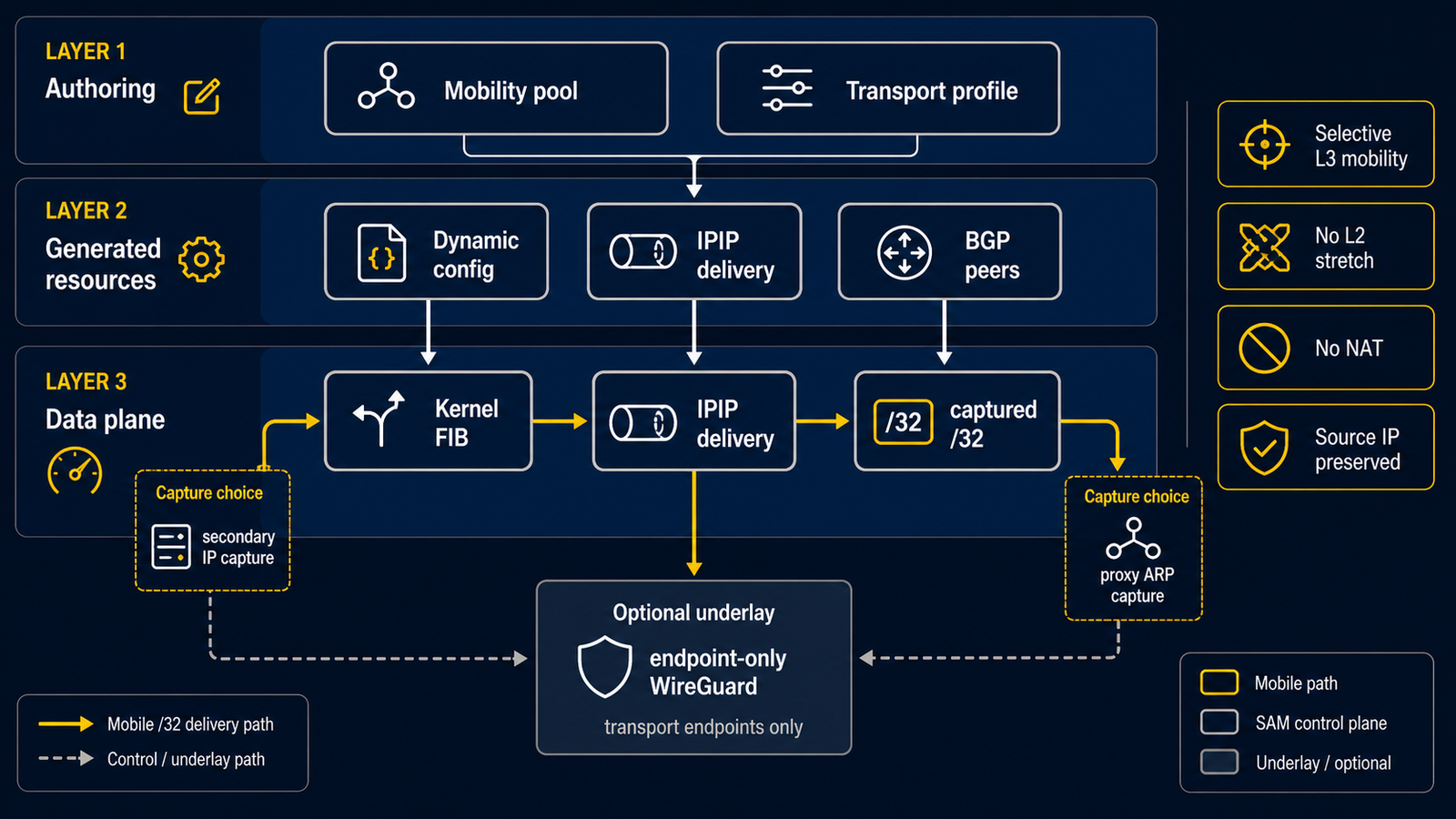
Selective Address Mobility captures selected /32 IPv4 addresses at one side
and delivers packets for those addresses to the owning side over a
routerd-to-routerd overlay. TCP/IP source and destination addresses are
preserved by the abstraction. Firewall and NAT are separate routerd layers, not
fields on mobility resources.
Resource Model
For the CloudEdge Mobility control plane, SAMNodeSet is the shared
operator-authored identity/topology intent and MobilityPool is the local
address/capture intent. The pool declares the logical IPv4 pool, EventGroup,
BGP delivery, local capture policy, and provider trap details. The node set is
the one shared record of every participant's identity, site, role, placement,
and transport endpoint; a pool does not repeat remote members.
The north-star config shape is:
- declare the full shared identity/topology and placement once in a
SAMNodeSet, then import it withMobilityPool.spec.membersFrom; - declare only the self site as a local MobilityPool overlay, including its capture and provider discovery details;
- keep reusable local cloud capture details in
profiles.cloudCaptures; - keep non-secret node-local values in
spec.values, then project them withcapture.targetFromandownershipDiscovery.subnetRefFrom.
SAMNodeSet is the write-once aggregation point for a fabric. It supplies the
shared MobilityPool membership fields (nodeRef, site, role, and optional
placement/maintenance) as well as Event Federation, WireGuard, and SAM
transport identity. Provider references, capture details, discovery selectors,
profiles, and static owned addresses remain a local MobilityPool overlay.
SAMTransportProfile topology derivation from a node set uses
addressingMode: pair-stable so adding a node does not renumber existing tunnel
/31 assignments.
SAMNodeSet.spec.nodes[].macAddresses can list static member MAC addresses for
the same fabric. On-prem ARP observers use the union of those MAC addresses as
an ignore set so ARP frames from routerd members do not become ownership signals
for mobile /32 addresses. Editing macAddresses is declarative intent:
routerd derives the observer ignore set and reconciles it through the observer
socket without requiring an observer or routerd restart. Observer status reports
the active ignore set and ignored observation count so convergence is visible.
apiVersion: mobility.routerd.net/v1alpha1
kind: SAMNodeSet
metadata: { name: svnet1-nodes }
spec:
  nodes:
    - nodeRef: pve-rt01
      site: pve01
      role: onprem
      eventEndpoint: http://10.99.0.11:9443
      samEndpoint: 10.99.0.11
      wireGuard:
        publicKey: "${PVE_RT01_WG_PUBLIC_KEY}"
        allowedIPs: [10.99.0.11/32]
    - nodeRef: rr01
      site: backbone
      role: cloud
      routeReflector: true
      eventEndpoint: http://10.99.0.1:9443
      samEndpoint: 10.99.0.1
      wireGuard:
        publicKey: "${RR01_WG_PUBLIC_KEY}"
        endpoint: rr01.example.net:51820
        allowedIPs: [10.99.0.1/32]
A pool can import one or more node sets. Imported members are added first and
local spec.members entries are overlaid by nodeRef, so a leaf can keep only
its self member with capture/discovery details while still learning the shared
topology from the node registry.
When an overlay matches a sourced node, it may contain nodeRef plus only its
local profileRef, capture, static-owned-address, and discovery fields.
site, role, placement, maintenance, and secondary-IP capacity belong
exclusively to SAMNodeSet; an overlay cannot change them.
apiVersion: mobility.routerd.net/v1alpha1
kind: MobilityPool
metadata: { name: svnet1 }
spec:
  prefix: 10.88.60.0/24
  groupRef: svnet1
  membersFrom:
    - resource: SAMNodeSet/svnet1-nodes
  members:
    - nodeRef: pve-rt01
      capture:
        type: proxy-arp
        interface: vmbr0
      ownershipDiscovery:
        mode: onprem-l2
        sources:
          - type: pve-svnet
            bridge: vmbr0
If a required membersFrom SAMNodeSet is not present, the pool reports
Pending. Mark the source optional: true only when a partial local member list
is acceptable during bootstrap. Node-set membership is declarative router
configuration, not a dynamic RR cache, so MobilityPool planning never depends on
an HTTP membership-sync endpoint.
WireGuard interfaces can import peers from the same node registry:
apiVersion: net.routerd.net/v1alpha1
kind: WireGuardInterface
metadata: { name: wg-svnet1 }
spec:
  selfNodeRef: pve-rt01
  privateKeyFile: /usr/local/etc/routerd/secrets/wg-svnet1.key
  listenPort: 51820
  peersFrom:
    - resource: SAMNodeSet/svnet1-nodes
WireGuardInterface.spec.peersFrom reads
SAMNodeSet.spec.nodes[].wireGuard and generates ordinary WireGuard peer
entries from publicKey, endpoint, allowedIPs, and
persistentKeepalive. The node whose nodeRef matches selfNodeRef is
skipped; when selfNodeRef is omitted, Router.metadata.name is used. Imported
peers are added first, then static WireGuardPeer resources are overlaid by
metadata.name, so a hand-authored peer named like the remote nodeRef remains
a bootstrap or emergency override. If a required source is missing, the
interface reports Pending and routerd leaves the current WireGuard runtime
config untouched.
When privateKeyFile is set and the file is absent, a non-dry-run apply creates
the parent directory with restrictive permissions and writes a new WireGuard
private key with mode 0600. Existing non-empty key files are never
overwritten. Dry-run and plan paths remain non-mutating. The interface status
publishes the derived publicKey when it can observe WireGuard runtime state or
derive it from configured key material.
For hub/spoke deployments, peersFrom removes repeated peer authoring after a
trusted node registry exists, but it does not by itself solve first-contact
registration. ADR 0015 describes a
proposed WireGuard peer enrollment flow where leaf routers submit their
WireGuard identity to a fixed RR/spine endpoint over a non-WireGuard bootstrap
path, and the RR/spine approves the registration before it becomes generated
peer input.
For example, on an AWS router:
apiVersion: mobility.routerd.net/v1alpha1
kind: SAMNodeSet
metadata: { name: lab-same-subnet-nodes }
spec:
  nodes:
    - nodeRef: onprem-router
      site: onprem
      role: onprem
    - nodeRef: cloud-router
      site: aws
      role: cloud
      placement:
        group: aws-edge
        priority: 10
      maintenance:
        drain: false
    - nodeRef: azure-router
      site: azure
      role: cloud
      placement:
        group: azure-edge
        priority: 10
    - nodeRef: oci-router
      site: oci
      role: cloud
      placement:
        group: oci-edge
        priority: 10
---
apiVersion: mobility.routerd.net/v1alpha1
kind: MobilityPool
metadata: { name: lab-same-subnet }
spec:
  prefix: 10.0.0.0/24
  groupRef: cloudedge
  membersFrom:
    - resource: SAMNodeSet/lab-same-subnet-nodes
  values:
    self.region: ap-northeast-1
    self.subnetRef: subnet-0123456789abcdef0
  profiles:
    cloudCaptures:
      aws-self:
        capture:
          type: provider-secondary-ip
          providerRef: aws-lab
          nicRef: eni-0123456789abcdef0
          targetFrom:
            region: self.region
        ownershipDiscovery:
          mode: provider-private-ip
          scanInterval: 60s
          subnetRefFrom: self.subnetRef
          # Empty/hold keeps a stopped instance as an ownership fact; release
          # expires it instead.
          stoppedInstancePolicy: hold
  members:
    - nodeRef: cloud-router
      profileRef: aws-self
On the on-prem node, the self overlay normally carries
staticOwnedAddresses and a proxy-arp capture with an explicit
activeWhen.type. Use single-router when one local router owns capture for
the site, or vrrp-master when an HA pair gates capture by VRRP master state.
activeWhen is supported only for this on-prem proxy-arp capture; a cloud
provider-secondary-ip capture is rejected if it sets the field, so a local
VRRP transition can never create a provider assignment without its matching
BGP and local-dataplane plan.
For discovery of dynamic on-prem clients beyond this bootstrap owner, add
ownershipDiscovery with mode: onprem-l2 and at least one source (for
example type: arp-observer on ens21). The complete cloud and on-prem
topology remains in SAMNodeSet; the local router owns only its local
implementation details.
routerd uses observed facts from federation or provider discovery to advertise
owned /32 paths through BGP. Operators keep the control plane declarative by
editing only MobilityPool; per-address advertisements and provider trap action
plans are derived by the controller.
For same-provider cloud router maintenance,
SAMNodeSet.spec.nodes[].placement.group elects one non-drained active capture
member by priority and then nodeRef. Its maintenance.drain: true removes
that member from active selection, so only the active member emits provider trap
actions while every member can advertise its BGP standby path. Distribute the
same SAMNodeSet identity and placement source to every node; each node's
MobilityPool keeps only its local self overlay, which preserves deterministic
placement without repeating remote member details.
North-Star Field Reference
spec.values
: Non-secret local values used while normalizing this node's config. Use this
for region names, compartment IDs, resource group names, subnet IDs, NIC names,
and similar identifiers. Do not put credentials, tokens, private keys, or
account secrets here.
spec.profiles.cloudCaptures.<name>.capture
: Reusable defaults for a local cloud provider-secondary-ip capture. A member
can opt in with members[].profileRef. Explicit member fields override the
profile.
spec.profiles.cloudCaptures.<name>.ownershipDiscovery
: Reusable defaults for provider private-IP inventory scanning. If
ownershipDiscovery.providerRef is omitted, it inherits the effective
capture.providerRef.
members[].profileRef
: Applies a named cloud capture profile to that member. Use it for the local
self member. It is invalid on remote members.
members[].capture.targetFrom
: Maps generated provider action target keys to keys in spec.values. Explicit
capture.target entries win when both are present.
members[].ownershipDiscovery.subnetRefFrom
: Resolves ownershipDiscovery.subnetRef from spec.values when the explicit
field is empty.
SAMNodeSet.spec.nodes[].placement and .maintenance
: Declare deterministic active/standby capture placement and drain state in the
shared node registry. MobilityPool.spec.members is only the local self
overlay after membersFrom; do not repeat remote identity, placement, or
maintenance fields there.
The shared membership belongs in SAMNodeSet. The older inline shape, where a
pool repeats remote-node identity or provider details, is not a valid authoring
model; a pool imports the node set and carries only its local overlay. Provider,
capture, and discovery details belong only to the corresponding node's local
pool.
Transport Profile
SAMTransportProfile is the higher-level transport profile for BGP-mode SAM.
It derives the per-peer TunnelInterface, endpoint /32 IPv4Route, and
BGPPeer resources that carry mobility paths. Current CloudEdge examples use
IPIP as the default SAM delivery plane. WireGuard, when present, is an
encryption underlay only: generated or hand-authored WireGuard peers should keep
AllowedIPs to transport endpoint prefixes, not mobility /32s.
Each router must declare spec.selfNodeRef; routerd does not infer the local
node identity from hostname or BGP router ID.
spec.addressingMode controls /31 slot derivation:
edge-index(default): profiles use the sameSAMNodeSetthroughspec.peersFrom. The controller sorts that shared node list and ranks each unordered node pair before allocating a/31fromspec.innerPrefix.pair-stable: each peer edge derives a slot from a stable hash, so leaf/router profiles can select only their actual peers without changing the shared node set.
For production fabrics, prefer /20 or larger innerPrefix where practical;
smaller pools such as /24 (128 /31 slots) collide more easily under
hash+mod allocation.
spec.peersFrom can reference SAMNodeSet/<name>, SAMPeerGroup/<name>,
SAMEnrollmentPolicy/<name>, or a fetched SAMRRSet/<name>. A SAMNodeSet
source contributes every
spec.nodes[].nodeRef to the resolved topology. It creates peers for every
non-self node with a samEndpoint, unless nodeRefs narrows the source to the
listed adjacent nodes. The generated peer uses that samEndpoint as
remoteEndpoint. A generic SAMPeerGroup source contributes reusable transport
peers through the peer-group sync cache. SAMPeerGroup is runtime-only, not a
top-level spec.resources kind.
An enrollment policy can also offer an opportunistic direct-leaf group. The
leaf still consumes its fetched SAMRRSet first, then adds the policy-scoped
group with direct: true:
peersFrom:
  - resource: SAMRRSet/pve-rrs
  - resource: SAMPeerGroup/pve-direct-leaves
    direct: true
This second form is delivered atomically with the RRSet by the authenticated
enrollment fetcher; it is not a static resource and does not use the generic
sync cache. Direct mode requires addressingMode: pair-stable, leaves
routeReflectorClient false, and gives direct imports a higher local preference
than RR imports. A direct profile must explicitly set the ordinary RR
importPolicy.localPreference. This is deliberately BGP local preference, not an
administrative-distance or AS-path heuristic: RR reflection in iBGP does not
reliably express the extra forwarding hop in AS_PATH. The direct default is
200; set the two values explicitly when the fabric has another preference
convention:
bgp:
  importPolicy:
    localPreference: 100 # RR peers
    nextHopRewrite: peer-address
  directLocalPreference: 200 # direct peers; must be greater than RR
For the RR import, leave nextHopRewrite unset (its default is
peer-address) or set it explicitly as above. Do not use unchanged on a
direct profile: an RR-reflected route may have been originated by a third leaf,
but its reachable next hop is the immediately connected RR tunnel. For a
legacy direct profile, routerd safely normalizes an explicit unchanged to
peer-address at runtime so the daemon can start and the YAML can be replaced.
Update the YAML to the explicit form above; non-direct profiles retain their
normal unchanged behavior. This setting only chooses the forwarding next hop
after a route is learned; it does not affect whether an optional direct peer is
admitted.
A missing, expired, incompatible, or unreachable direct group does not make the profile pending and never removes the RR-generated tunnel or BGP peers. In short: direct is an optimization; RR is the fallback.
The controller resolves all sources at reconcile time. Direct peer and topology
lists are not accepted: SAMNodeSet is the single identity/topology/endpoint
input, while nodeRefs expresses only adjacency. If a required peersFrom
source is not yet present, the profile reports Pending; optional sources are
ignored until they arrive. If the source was fetched before and only its
dynamic-config TTL has expired, routerd reports the source as Stale and keeps
using the last-known-good peer group instead of removing generated transport
artifacts.
SAMNodeSet entries may provide either a static samEndpoint or
samEndpointFrom. The latter reads a status field such as
DHCPv4Client/<name>.currentAddress or Interface/<name>.primaryIPv4, strips
any prefix length, and feeds the resolved IPv4 address into generated peer
remoteEndpoint values. When the source is not resolved, the transport profile
stays Pending instead of generating a tunnel with a stale endpoint.
apiVersion: mobility.routerd.net/v1alpha1
kind: SAMTransportProfile
metadata: { name: cloudedge-transport }
spec:
  selfNodeRef: pve-rt01
  mode: ipip
  addressingMode: pair-stable
  innerPrefix: 10.255.0.0/20
  underlayInterface: wg-svnet1
  localEndpointFrom:
    resource: Interface/wg-svnet1
    field: primaryIPv4
  bgp:
    routerRef: BGPRouter/mobility
    peerASN: 64512
  peersFrom:
    - resource: SAMNodeSet/svnet1-nodes
Spine or route-reflector profiles can set spec.publishPeerGroup: true. In that
mode routerd publishes a SAMPeerGroup DynamicConfigPart with this profile's
selfNodeRef and concrete local endpoint. localEndpointFrom is resolved before
publishing so leaves receive a direct remoteEndpoint value.
When routerd serve runs on a node with publishPeerGroup: true, it also
serves published peer groups over the transport network on TCP port 19652
(GET /v1/peer-groups). A leaf with a missing required peersFrom group tries
to query WireGuard peers reachable through spec.underlayInterface; a matching
group is stored locally as peer-group-sync/<group-name> with the normal
dynamic-config TTL. If the publisher disappears or the group expires, the leaf
does not tear down the generated tunnel or BGP peer. It reuses the expired
record as last-known-good input, reports the source as Stale, and keeps the
existing transport artifacts rendered. Stale peer sources include a status
warning for long-lived fail-static operation. A never-seen required group still
reports Pending.
MobilityPool membership is resolved directly from SAMNodeSet resources. It is
not published through the transport sync service, so BGP placement receives one
canonical identity/topology input and only SAMPeerGroup remains dynamically
synchronised.
apiVersion: mobility.routerd.net/v1alpha1
kind: SAMNodeSet
metadata: { name: cloudedge-nodes }
spec:
  nodes:
    - { nodeRef: onprem-router, site: onprem, role: onprem, routeReflector: true, samEndpoint: 10.252.0.1 }
    - { nodeRef: aws-router-a, site: aws, role: cloud, samEndpoint: 10.252.0.2 }
    - { nodeRef: azure-router, site: azure, role: cloud, samEndpoint: 10.252.0.3 }
---
apiVersion: mobility.routerd.net/v1alpha1
kind: SAMTransportProfile
metadata: { name: cloudedge-transport }
spec:
  selfNodeRef: aws-router-a
  mode: ipip
  encryption: wireguard
  innerPrefix: 10.255.0.0/24
  underlayInterface: wg-hybrid
  localEndpointFrom:
    resource: Interface/wg-hybrid
    field: primaryIPv4
  bgp:
    routerRef: BGPRouter/mobility
    peerASN: 64512
    timersPreset: fast
  peersFrom:
    - resource: SAMNodeSet/cloudedge-nodes
      nodeRefs: [onprem-router]
Core routers can set spec.bgp.routeReflectorClient and
spec.bgp.routeReflectorClusterID; those fields are copied to each generated
BGPPeer. When routeReflectorClient is true, routerd also hardens the
generated peer import policy for that leaf: imported routes must be /32s under
the configured importPolicy.allowedPrefixes or, when that list is omitted, the
declared MobilityPool prefixes. They must carry that leaf's node-identity
community and must not carry another topology node's node-identity community.
This keeps the RR admission boundary tied to the declared SAM topology; a leaf
cannot claim another node identity or advertise a broader mobility prefix through
the generated RR session. A compromised leaf can still advertise a pool-local
/32 with its own identity; constraining per-node ownership requires a separate
authorization signal beyond this route filter. Edge routers can leave the RR
fields unset and use ordinary iBGP sessions.
When a static RR intentionally has no local MobilityPool, its generated
RR-client peers also provide the typed transit FIB authority. Set
spec.bgp.importPolicy.allowedPrefixes explicitly to each mobility prefix and
set both prefix-length bounds to 32; validation rejects an unbounded no-pool
RR. routerd then installs only an exact
owner/return mobility /32 received from that generated peer, with the
peer's required/forbidden node-identity communities. A generic BGPRouter
import policy is not used as transit authority, and an RR must not add a
placeholder MobilityPool merely to forward leaf-owned routes.
Peer removal replaces the profile's generated DynamicConfigPart with the new
resource set. Profile deletion replaces the old part with an empty active part,
so effective config drops generated tunnel, BGP peer, and endpoint route
resources. The generated resources then clean up through normal owner-reference
GC and resource-specific teardown.
CloudProviderProfile describes provider capabilities and how an external
tool would authenticate. The mobility planner does not call provider APIs
directly. For cloud capture it emits dry-run ActionPlan records such as
assign-secondary-ip and ensure-forwarding-enabled; the separate
provider-action executor path may import and execute those only when explicitly
allowed by ProviderActionPolicy.
OverlayPeer identifies a remote routerd peer and underlay for ordinary L3
HybridRoute delivery. Mobility /32s use BGP delivery through
SAMTransportProfile.
Capture And Delivery
Supported capture types:
| Type | Meaning |
|---|---|
provider-secondary-ip | The cloud fabric captures the /32 through a provider-owned secondary address object or equivalent. |
proxy-arp | A site router answers ARP locally for a selected address. |
Reserved capture types rejected by MVP validation:
| Type | Status |
|---|---|
static-host-route | Reserved for a later dataplane design. |
garp | Reserved for a later dataplane design. |
MobilityPool always uses BGP delivery. Owned addresses are advertised as IPv4
unicast /32 paths; non-owners import the BGP best path into the local FIB over
the selected overlay next hop.
members[].capture.target carries non-secret provider target hints copied into
generated provider ActionPlan.target values. Put identifiers such as region,
compartment ID, resource group, NIC name, or IP config name there; credentials,
tokens, and private keys must stay in provider auth mechanisms.
Cloud provider-secondary-ip capture derives ordinary secondary-ip behavior
from its type; do not configure that redundant strategy. Azure may instead
set captureStrategy: route-table: Azure writes a UDR in capture.target.routeTableRef
with NextHopType=VirtualAppliance and requires
capture.target.nextHopIPAddress. Provider inventory must confirm that
the route table points at the local router before routerd advertises the captured
/32 to BGP. This provider-observation gate is specific to the route-table
strategy; secondary-ip capture does not use route-table observation to decide
when to advertise the overlay holder.
The current lab certification covers secondary-ip capture only. The
route-table strategy is uncertified until provider observation, BGP
advertisement coupling, and provider API delay behavior have been validated in
the release lab. Its design intentionally waits for provider route-table
observation before advertising the captured /32, so ARM/API latency can delay
overlay convergence for this strategy.
Same-subnet limitation (validated in #516):
AWS rejects VPC-internal /32 route destinations, and OCI rejects intra-subnet
VCN route rules. For the primary same-subnet lift-and-shift use case,
route-table is effective only on Azure. AWS and OCI must use secondary-ip.
For BGP-mode on-prem proxy-arp capture, members[].capture.sourceAddress
optionally declares the router's local sender address on the capture
interface. routerd lowers this to an IPv4StaticAddress /32 and uses it as
the capture-prefix route preferred source. This is useful when the capture
interface otherwise has no IPv4 address: Linux ARP for local same-subnet
clients then uses an address inside the mobility prefix instead of falling back
to an unrelated management address.
If that sender address is owned by another lifecycle manager such as DHCP/IPAM,
use members[].capture.sourceAddressFrom instead. For example,
resource: DHCPv4Client/svnet1-source with field: currentAddress uses the
leased address as the capture-prefix route preferred source without lowering it
to an IPv4StaticAddress, so routerd does not duplicate ownership of the same
address.
Use members[].capture.excludeAddresses for local-only addresses inside the
mobility prefix that must never be proxy-ARP captured across the extended
segment. On PVE Simple SDN, for example, each host may own the same local
gateway address such as 192.168.123.1/32; excluding it prevents generated BGP
proxy-neighbor capture for that address and splits the capture-prefix route so Linux
does not send local gateway ARP across the SAM capture path.
SAM does not provide transparent DHCP broadcast extension. Keep DHCP ownership
with the local fabric, VPC/VNet/VCN, or PVE IPAM. A DHCPv4Client used by
sourceAddressFrom should usually set useRoutes: false and useDNS: false
when it exists only to learn the capture-interface source address. DHCP lease
observations can participate in ownership discovery, but they should be combined
with arp-observer, on-demand-arp, or PVE svnet observations when the IPAM
source is outside routerd.
Passive sources cannot prove that zero clients exist. By default, an on-prem L2
discovery member with no observed clients remains pending. To make an empty
segment an explicit operational policy, set ownershipDiscovery.allowEmptyAfter
to a duration such as 2m; after the sources have been armed for that duration,
routerd marks discovery Complete and publishes discoveryObserved: 0
plus freshness timestamps in status.
on-demand-arp also performs a conservative proactive sweep of the mobility
prefix: one ARP target is probed per source scanInterval, using the same
probeTimeout, probeRetries, probeCooldown, and sourceAddressFrom
settings as demand-triggered probes. This lets quiet, already-running L2
clients become observed without a manual arping or ping from the owner side.
Keep scanInterval conservative on broad prefixes; for /24 lab validation a
short interval such as 1s gives fast convergence while still limiting traffic
to one active ARP probe per second.
For faster discovery across separate leaf L2 segments, configure authenticated
Event Federation listen and peer delivery on the pool's EventGroup. A leaf
that sees an unresolved ARP request records
routerd.mobility.arp.request.observed with a 45-second lifetime. Every remote
pool member validates the group, source membership, pool, prefix, discovery
scope, subject, and expiry before asking its local on-demand-arp observer to
probe only that target. The source leaf is skipped, received facts are not
re-forwarded, and the observer's normal target cooldown suppresses duplicate
packets. This follows the EVPN Proxy ARP model of suppressing known bindings and
flooding a lookup miss, while keeping SAM's dataplane L3/IPIP rather than
carrying raw ARP frames over the overlay. If EventPeer.spec.types is non-empty,
add routerd.mobility.arp.request.observed; an empty list already carries the
new fact. Without Event Federation peers, the proactive prefix sweep remains
available as the compatibility fallback.
For proxy-arp capture on Linux, routerd:
- enables
net.ipv4.conf.<capture-interface>.proxy_arp=1through the normal sysctl controller, - installs a proxy neighbor entry equivalent to
ip neigh add proxy <address> dev <capture-interface>, and - enables
net.ipv4.ip_forward=1through the normal sysctl controller.
BGP-mode on-prem proxy-ARP members can opt in to a GARP after the node is
observed as the /32 holder. Remote capture remains silent, so an on-prem to
cloud move can still leave a bounded stale-neighbor window on the old on-prem
segment until existing neighbor cache entries expire.
For provider-secondary-ip in BGP mode, the provider fabric owns address
capture and routerd never assigns the mobile /32 to the local OS. The cloud
provider secondary IP is only the provider-fabric ingress owner, and the Linux
FIB forwards the packet through the selected overlay path instead of treating it
as a local destination. On Linux routerd removes that specific address from
local interfaces if cloud-init, netplan, or another guest agent adds it back. It
then ensures IPv4 forwarding, explicit proxy-neighbor state for provider ingress
when needed, and per-interface forwarding state; the overlay /32 delivery
route comes from BGP best-path import. routerd does not re-add the address when
the capture is removed, because it never owns the guest OS assignment.
Status reports this as captureOSAddressAbsence. enforced: true means
routerd is actively enforcing that the captured address is absent from local OS
interfaces. lastReconcileRemoved: true means the most recent reconcile
actually removed the address; it is normally false in steady state once the
address is already absent. reason identifies the BGP provider-secondary
no-local-address projection.
Inspecting Ownership
MobilityPool status exposes one ownership view:
ownershipResolverControlPlaneOwnerTableis the only per-address operational projection. It is used bydoctor sam, FIB policy checks, and operators. It keeps one deterministic row per observed mobility address and includes the selected owner node/provider/NIC/subnet/resource, local evidence node/provider/NIC/subnet/resource/source, capture state and finalcaptureDisposition/captureReason, advertise/suppression state, and conflict reason/winner/resolution when present.
Use routerctl mobility owners to inspect the control-plane table without
pattern-matching raw status JSON:
routerctl mobility owners
routerctl mobility owners --pool cloudedge --address 10.77.60.10/32 -o json
Use routerctl mobility explain to render one owner-table row together with
pool-level provider status for one address:
routerctl mobility explain --pool cloudedge --address 10.77.60.10/32
routerctl mobility explain --pool cloudedge --address 10.77.60.10/32 -o json
OwnershipResolved comes from that row. Provider status is intentionally
address-scoped only when the pool status names the address:
providerActionFailedAddresses makes ProviderActionApplied=False, and
providerObservationPendingAddresses makes ProviderObserved=False. For all
other addresses those conditions are Unknown; a pool-level provider phase is
not incorrectly projected as a failure for every address. FIB installation and
reachability remain external checks, reported as Unknown until doctor sam
or a dataplane probe verifies them.
Rows are sorted by pool and address. When a remote provider owner overlaps local
evidence, or when two fresh provider owners claim the same /32, the row state
is Conflict and conflictReason explains the condition. Expired ownership
events are not retained as live conflicts. Duplicate provider-owner conflicts
also include conflictWinnerNode and conflictResolution: the healed BGP owner
wins when present; otherwise the lowest stable owner key wins (nodeRef,
provider ref, resource ref, NIC ref, subnet ref, then address), independent of
provider scan recency. Losing nodes with an observed local
provider-secondary capture report loser-release-local-capture and release only
that local capture after the stale-capture hold-down. routerctl doctor sam consumes the
same ownership state for conflict checks and, with host checks enabled, compares
endpoint-owned local rows with the Linux main FIB. Provider-secondary BGP
capture-holder rows are not local endpoint owners, so they are not required to
resolve as local/cloud routes; delivery/forwarding checks and dataplane probes
prove that path.
FreeBSD and other non-Linux hosts do not have live SAM local capture. The
MobilityPool planner rejects proxy-ARP capture on FreeBSD rather than accepting
a configuration that cannot safely provide the Linux contract:
owned proxy-neighbor capture, gratuitous ARP, and the narrow routerd-owned
forwarding path. Provider-secondary capture configuration and the surrounding
SAM/BGP control plane remain portable, but their local capture status stays
CaptureUnsupported until an equivalently owned FreeBSD dataplane is approved.
The live Linux dataplane has been smoke-tested in an Azure + PVE same-subnet lab. Treat it as pre-release behavior and validate the exact provider and firewall policy before production use.
Reverse Path Filtering
Strict reverse-path filtering can drop forwarded SAM traffic because the mobile
/32 may appear to belong to a directly attached subnet while the return path
is through the overlay. routerd does not silently change rp_filter for SAM,
because that is an invasive interface policy decision.
routerctl doctor hybrid reads
net.ipv4.conf.<capture-or-tunnel-interface>.rp_filter when host checks are
enabled. It warns when the value is strict (1) and recommends evaluating loose
mode (2) on the affected interfaces.
Provider Capabilities
| Provider | MVP capability descriptor |
|---|---|
| Azure | NIC secondary IP plus IP forwarding enabled on the router NIC. Route-table (UDR) capture also available for same-subnet /32 (NextHopType=VirtualAppliance, limit 1000). |
| AWS | ENI secondary private IPv4 plus source/destination check disabled. Route-table capture rejected for VPC-internal /32. |
| OCI | VNIC private IP object plus source/destination check disabled. VCN route-rule capture rejected for intra-subnet /32. |
| GCP | Alias IP or route capability, gated by the declared provider profile. |
The profile is declarative. The mobility planner can produce provider
ActionPlan records, but address assignment and NIC flag changes remain gated
by the provider-action execution policy and executor plugin. The planner itself
never mutates provider state.
Same-Subnet Flow
In a 10.0.0.0/24 lab, suppose 10.0.0.7/32 is the cloud VM address and
10.0.0.9/32 is the on-prem/PVE VM address. The goal is for the cloud VM at
10.0.0.7 to open a TCP connection to the on-prem VM at 10.0.0.9 while both
VMs keep local default gateways and no NAT is introduced.
- The cloud VM sends to
10.0.0.9. - Azure NIC secondary IP capture directs packets for
10.0.0.9/32to the cloud routerd node. - The cloud routerd node delivers the packet over the generated IPIP SAM
transport; if encryption is enabled, that IPIP packet rides over the
endpoint-only
wg-hybridunderlay. - The on-prem side forwards it to the owner of
10.0.0.9. - Source and destination IPs remain the original endpoint addresses.
The reverse path for 10.0.0.7/32 is captured on the on-prem side with
proxy-ARP. PVE LAN hosts reach .7 through the on-prem routerd node, which
delivers the packet over the same generated SAM transport to the cloud routerd
node.
The split example configs are:
examples/cloudedge-mobility-demo/contains the current MobilityPool-based cloud/on-prem configuration.
Firewall And NAT Composition
Selective Address Mobility lives in the ordinary switching/forwarding plane. It
does not contain nat, preserveSource, firewall, or zone fields. Address
transparency is intrinsic: the source and destination addresses are preserved.
To firewall or NAT a mobile address, reference its literal /32 in the
existing FirewallZone, FirewallRule, or NAT44Rule resources. The current
model has no cross-kind reference from firewall or NAT kinds to MobilityPool;
the coupling is intentionally loose by literal address. A named reference can
be added later if it proves useful.
SAM-forwarded traffic still traverses the existing firewall and conntrack path like any other forwarded traffic. Independence means the mobility resources do not configure arbitrary firewall or NAT policy; it does not mean bypass.
Conntrack cleanup design note
routerd briefly exposed a manual, scoped conntrack cleanup option for BGP SAM failover. It has been removed. In the reference SAM leaf configuration, routerd does not draw dataplane rules that engage conntrack for the delivered overlay flow, so the leaf-side scoped cleanup was a no-op and did not address failover flow anomalies.
The problem statement remains valid for future stateful SAM leaf designs: a
router that deliberately tracks forwarded mobile /32 flows may need a scoped
recovery hook when it becomes holder. Reintroduction should be designed around
detecting a routerd-managed ct-engage dataplane and enabling cleanup
automatically for that case. Do not reintroduce the feature as a manual opt-in
flag.
In particular, the delivered /32 traffic crosses the Linux firewall
FORWARD chain between the capture interface and the tunnel interface. Permit
that forwarding path for the captured address explicitly when the router has a
default-drop forwarding policy. The managed exceptions are narrow:
WireGuardInterface opens its Linux UDP listen port in INPUT, and the typed
MobilityPool local capture plan opens the capture-to-tunnel FORWARD path it
owns.
Overlay And Federation Addressing On Cloud Nodes
The Event Federation transport (the routerd-eventd listen address and each
EventPeer.endpoint), BGP/BFD peer addresses, and the SAM transport endpoint /
inner addresses generated by SAMTransportProfile must use address ranges you
control end to end on every node. If you place WireGuard underneath the SAM
transport, its interface/peer endpoint addresses have the same requirement. On
cloud instances, do
not draw overlay, BGP/BFD, or federation addresses from ranges the provider
reserves for its own internal use:
169.254.0.0/16(RFC 3927 link-local). Cloud instance metadata (IMDS) lives at169.254.169.254, and some images reserve the entire block: Oracle Cloud's Linux image routes all of169.254.0.0/16through anInstanceServiceschain, so a federation SYN to a169.254.xoverlay address is pulled to loopback and reset even though ICMP to the same address succeeds. AWS and Azure also use169.254.169.254for IMDS. Symptom: local ownership facts are present, butrouterd-eventdor BGP/BFD sessions never connect between nodes.100.64.0.0/10(RFC 6598 carrier-grade NAT). Used by CGNAT on provider underlays and by Tailscale (100.xtailnet addresses, MagicDNS). An overlay in this range collides with any Tailscale membership and with carrier NAT.
Use RFC 1918 ranges you reserve for SAM transport endpoints, the
SAMTransportProfile.innerPrefix, any optional WireGuard endpoint addresses,
and the routerd-eventd listen / EventPeer endpoints and BGP/BFD peering
addresses. Keep them distinct from the mobility pool /24 (the captured
addresses) and from every cloud-reserved range above. This applies to all
providers (AWS/Azure/OCI); OCI is simply the strictest at enforcing the
link-local reservation.
Client Endpoint Addressing vs Router-Overlay Reachability
A globally-unique /32 on a client guest's lo/dummy interface is not
reachable across cloud fabrics just because the guest OS owns the address. The
cloud fabric (VPC/VNet/VCN) only delivers destinations within the provider subnet
CIDR to a client ENI/NIC; a destination outside the VPC CIDR is dropped by the
fabric before it reaches the client, regardless of overlay routes on the routers.
Concretely, in a distinct-addressing 4-site test:
- Router endpoint
/32s on the overlay itself are reachable end-to-end (the routers carry them over WireGuard). A distinct-mesh of router endpoints passes 12 directed ping+SSH. - Client dummy/lo
/32s outside the VPC CIDR are not — the cloud fabric does not deliver them to the client ENI even with overlay routes and provider forwarding enabled.
Therefore: treat distinct-mesh shortcut endpoints as router endpoints only. To
give clients globally-unique, cross-fabric-routable addresses you need either
provider-routable client subnets or provider-assigned client IPs (a secondary IP /
captured address that the fabric actually delivers), not a guest-local dummy /32.
Do not confuse router-overlay reachability with client-fabric reachability when
designing a multi-site lab.
Out Of Scope
The MVP does not implement full L2 extension, EVPN, BUM forwarding,
broadcast/multicast extension, automatic ungated cloud API mutation, dynamic
patch/replace semantics, or automatic rp_filter changes.