DHCPv6-PD and AFTR on NTT NGN-style access networks
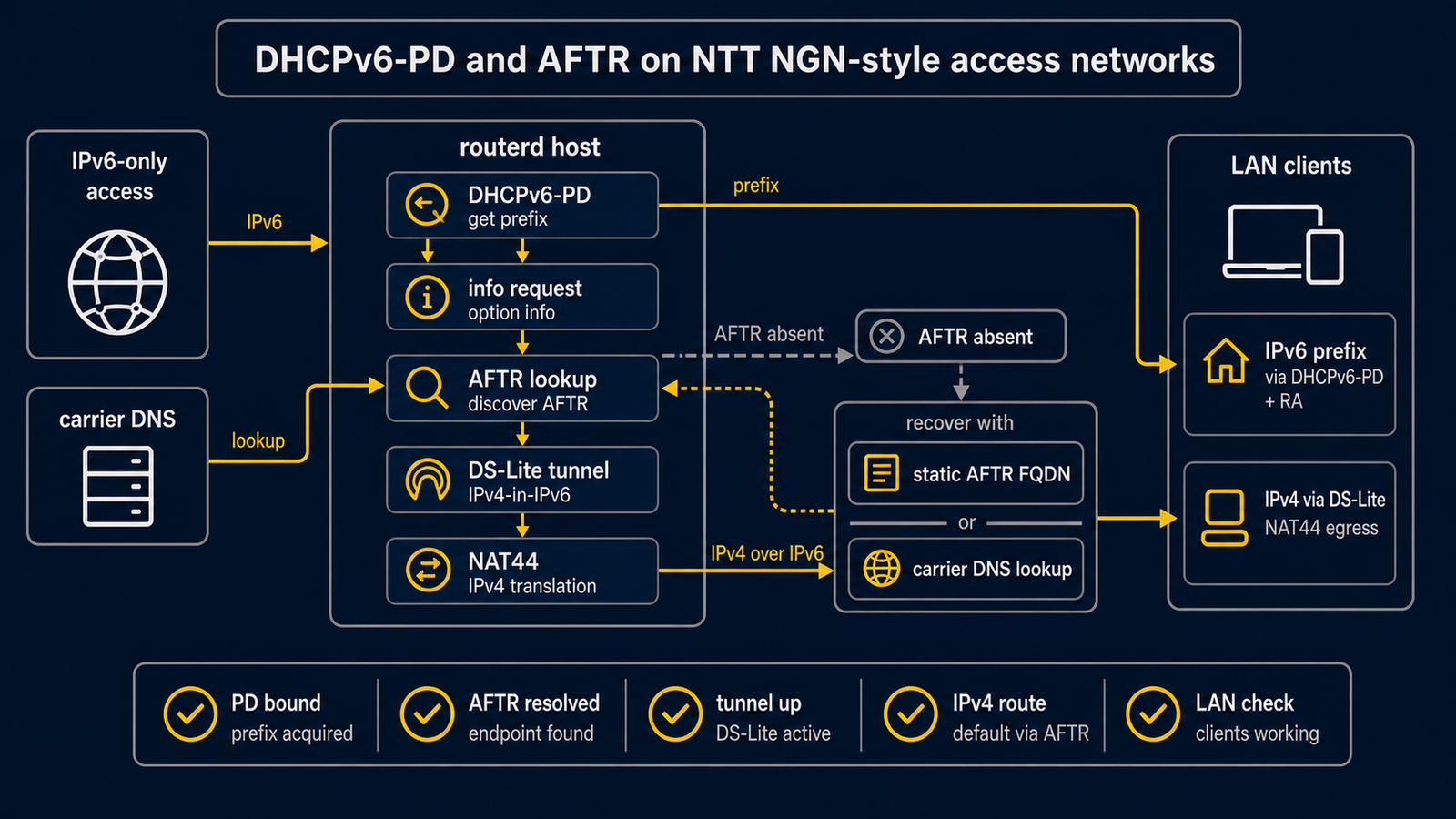
Field notes for routers placed behind a residential gateway that exposes an NTT NGN-style (Japan IPv6 fibre) IPv6 access network. The same patterns apply to other carriers that combine DHCPv6-PD with a DS-Lite path to an in-network AFTR.
DHCPv6-PD
routerd-dhcpv6-client obtains DHCPv6-PD reliably behind these residential gateways. There is no need for aggressive retries or unusual acquisition tricks; standard solicit / advertise / request / renew is enough.
What we have observed in steady state:
- Multiple routers behind the same RGW receive distinct prefixes (no collision).
- T1 / T2 renewals succeed indefinitely.
- The lease survives daemon restarts via
lease.json.
AFTR may not be returned in DHCPv6 information-request
For some RGW / ONU combinations, DHCPv6 information-request returns DNS, SNTP, and domain-search options but not the AFTR option. An empty AFTR field is normal in those cases.
For DS-Lite, supply the AFTR explicitly with one of:
DSLiteTunnel.spec.aftrIPv6— pin the AFTR's IPv6 address directly.DSLiteTunnel.spec.aftrFQDNwithspec.aftrDNSServers— resolve the FQDN through known carrier DNS servers.
AFTR FQDN often needs carrier DNS
Carrier-managed AFTR FQDNs (for example gw.transix.jp) typically resolve only through the carrier's own DNS servers. Public resolvers may answer with NXDOMAIN.
Configure those DNS server addresses on the DSLiteTunnel itself:
- apiVersion: net.routerd.net/v1alpha1
  kind: DSLiteTunnel
  metadata:
    name: ds-lite
  spec:
    interface: wan
    aftrFQDN: gw.transix.jp
    aftrDNSServers:
      - 2404:8e00::feed:101
With aftrDNSServers, the DS-Lite controller sends its AAAA lookup directly
to those carrier resolvers. DNSForwarder rules govern queries received by
routerd-dns-resolver; they do not configure the tunnel's AFTR lookup.
DS-Lite end-to-end checklist
When a DS-Lite tunnel is fully working you should see:
- The configured carrier DNS servers resolve the AFTR FQDN.
- An
ip6tnltunnel device exists. - The IPv4 default route points into the tunnel.
- nftables NAT44 is in place for outbound IPv4 from the LAN.
- Outbound IPv4 (HTTP, ICMP) succeeds from a LAN client.
Scope of these notes
These observations come from routerd evaluation labs that exercise the same RGW model the carrier ships. They are intended as guidance for similar deployments, not as a guarantee for every Japanese ISP plan or every RGW firmware revision. Treat them as a starting point for your own validation.