DS-Lite over DHCPv6-PD (IPv6-only access network)
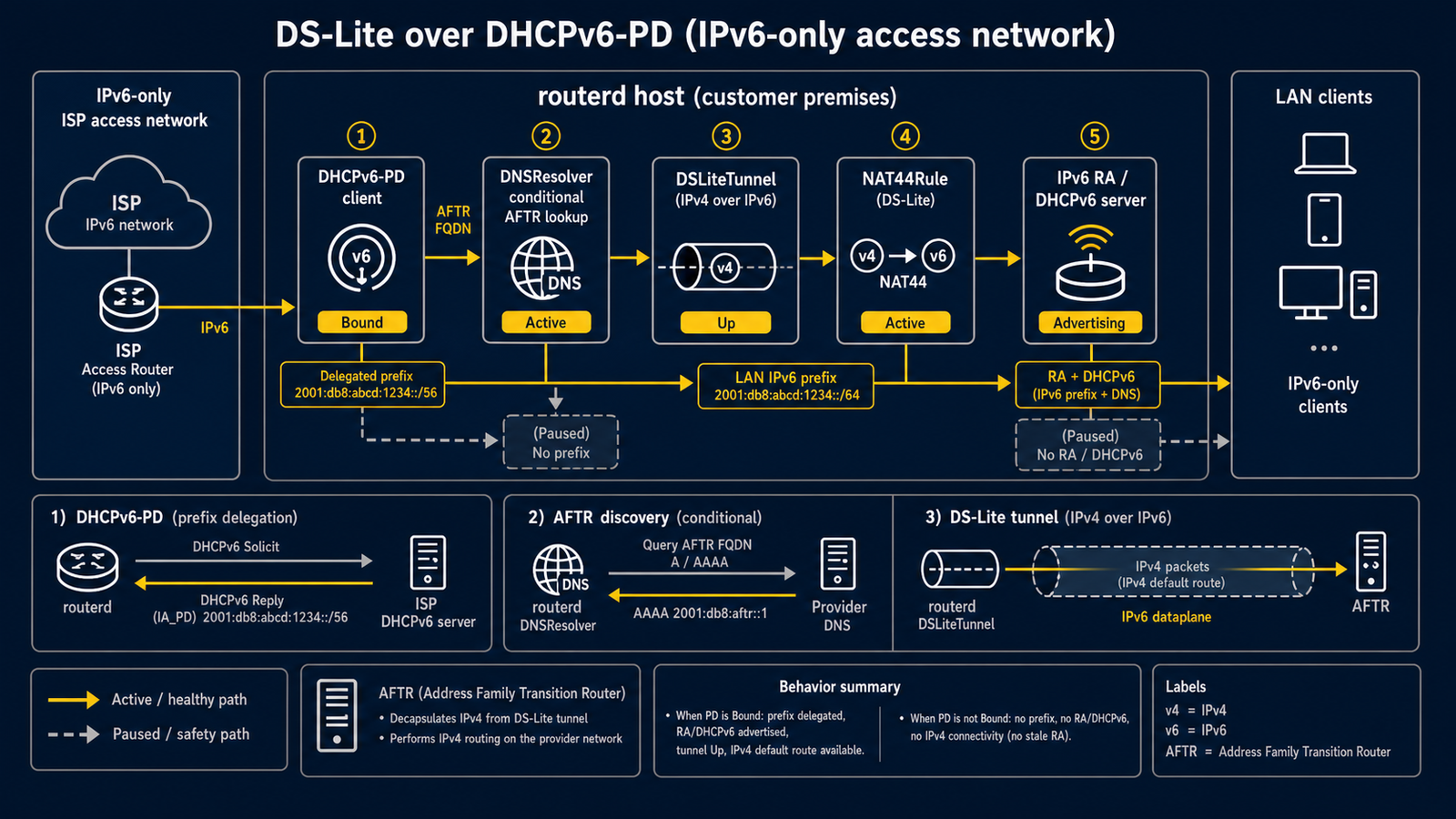
Scenario
The ISP delivers an IPv6-only access network and provides IPv4 connectivity through a DS-Lite tunnel to an Address Family Transition Router (AFTR). The router needs to:
- Take an IPv6 prefix via DHCPv6-PD and use it to address the LAN.
- Establish a DS-Lite (IPv4-in-IPv6 /
ip6tnl) tunnel to the AFTR. - Resolve the AFTR FQDN through the access-network DNS, since AFTR records are usually only authoritative inside the carrier network.
- Advertise IPv6 with RDNSS so SLAAC clients (Android included) get a working DNS server.
This pattern is common with several Japanese fibre carriers (NTT NGN with gw.transix.jp and similar AFTRs), but the configuration applies to any DS-Lite deployment.
Prerequisites
- The WAN-facing interface is connected to a residential gateway or ONU that runs an IPv6-only access network.
- DHCPv6-PD is available on that interface.
- The AFTR DNS records may or may not be returned in DHCPv6 information-request; always plan for both cases.
DHCPv6-PD
- apiVersion: net.routerd.net/v1alpha1
  kind: DHCPv6PrefixDelegation
  metadata:
    name: wan-pd
  spec:
    interface: wan
The lease is persisted at:
/var/lib/routerd/dhcpv6-client/wan-pd/lease.json
The daemon's status is available over its Unix socket:
curl --unix-socket /run/routerd/dhcpv6-client/wan-pd.sock http://unix/v1/status
LAN address derivation and RA
- apiVersion: net.routerd.net/v1alpha1
  kind: IPv6DelegatedAddress
  metadata:
    name: lan-from-pd
  spec:
    interface: lan
    prefixDelegation: wan-pd
    dependsOn:
      - resource: DHCPv6PrefixDelegation/wan-pd
        phase: Bound
    addressSuffix: "::1"

- apiVersion: net.routerd.net/v1alpha1
  kind: IPv6RouterAdvertisement
  metadata:
    name: lan-ra
  spec:
    interface: lan
    prefixFrom:
      resource: IPv6DelegatedAddress/lan-from-pd
      field: address
    oFlag: true
    rdnssFrom:
      - resource: IPv6DelegatedAddress/lan-from-pd
        field: address
The advertised RDNSS uses the LAN-side address derived from the delegated prefix. SLAAC clients pick up that resolver automatically.
AFTR DNS servers
The AFTR FQDN is normally only resolvable through carrier DNS. Configure those
DNS server addresses on the tunnel itself. DSLiteTunnel sends its AAAA lookup
directly to aftrDNSServers; it does not use a DNSResolver or a
DNSForwarder resource for this lookup.
DS-Lite tunnel
- apiVersion: net.routerd.net/v1alpha1
  kind: DSLiteTunnel
  metadata:
    name: ds-lite
  spec:
    interface: wan
    tunnelName: ds-routerd
    localAddressSource: interface
    aftrFQDN: gw.transix.jp
    aftrDNSServers:
      - 2404:8e00::feed:101
localAddressSource: interface uses the WAN-side IPv6 address that SLAAC/RA gave you (rather than a delegated-prefix-derived one) as the local endpoint of the tunnel. That address is usually available before LAN derivation finishes, so the tunnel comes up sooner.
Replace gw.transix.jp and the DNS server addresses with values your ISP
publishes. A separate DNSResolver can still serve LAN clients, but it does
not configure AFTR resolution for this tunnel.
If your ISP publishes a stable AFTR address and you prefer to skip DNS resolution, set aftrIPv6 directly:
spec:
  aftrIPv6: 2001:db8:cafe::1
When AFTR is not returned in DHCPv6 information-request (common with NTT NGN HGWs), the static aftrFQDN or aftrIPv6 configuration is the correct fallback.
For the tunnel inner IPv4 address, the normal DS-Lite example uses the RFC 6333 B4-AFTR link range 192.0.0.0/29.
If you need to carve an address from a LAN range instead, keep the address in an IPv4StaticAddress resource and reference it from DSLiteTunnel.localAddressFrom and NAT44Rule.snatAddressFrom.
See examples/dslite-lan-range-snat.yaml for the optional form.
Verification
# Before a daemon exists:
sudo routerd validate --config router.yaml

# After the local routerd daemon is running:
sudo routerctl plan -f router.yaml --replace
sudo routerctl get status

sudo ip -6 tunnel show
sudo ip route show default
sudo nft list table ip routerd_nat

# IPv4 reachability through the tunnel
sudo curl --interface ds-routerd https://1.1.1.1/
Only apply for real once the plan looks right and a rollback path is in place.