Supported platforms
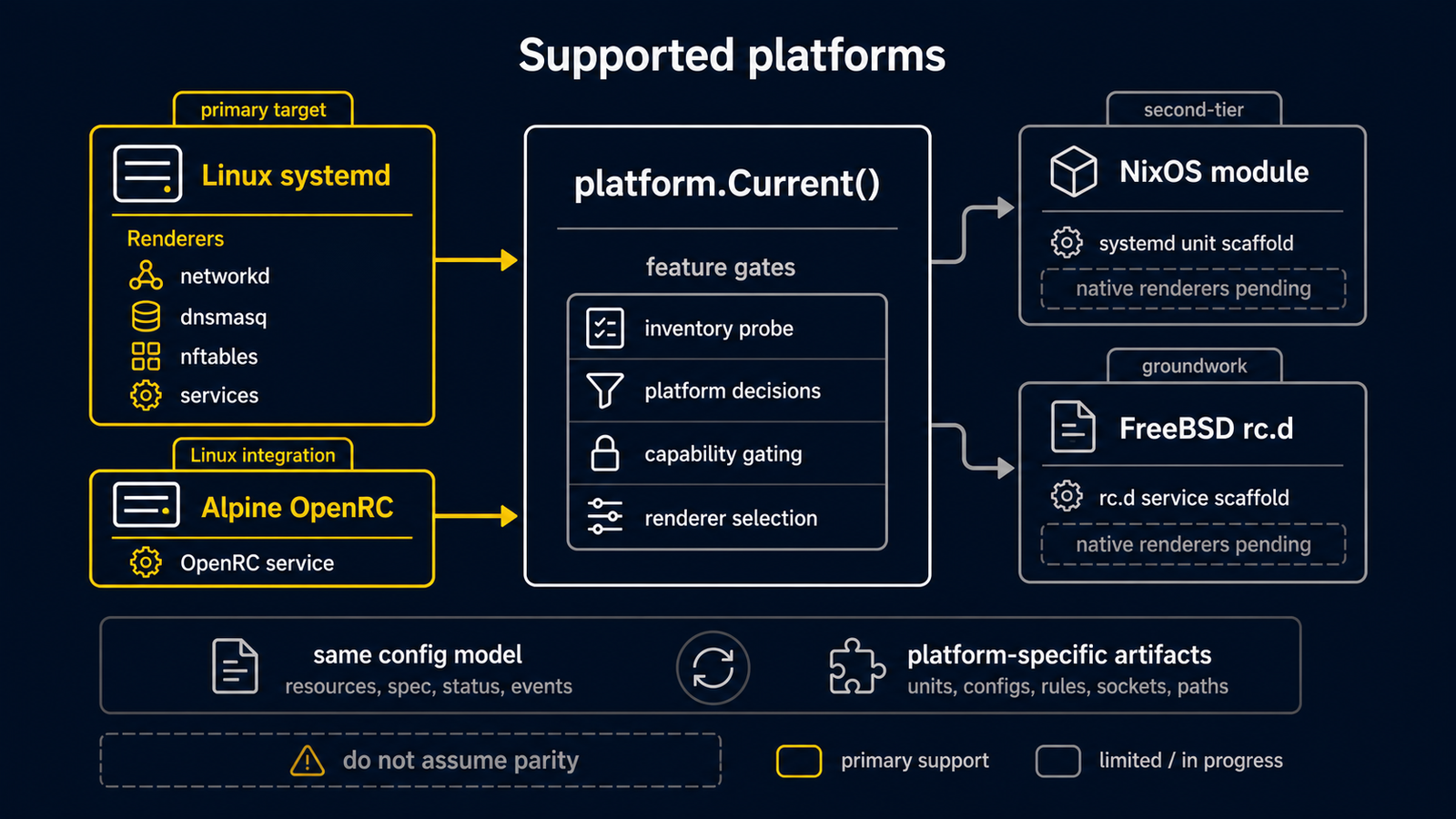
routerd is designed to be cross-OS, but each platform uses a different host integration model. This page lists the concrete OS surfaces routerd uses on each platform, so you can review generated files and runtime ownership before applying a router configuration.
Ubuntu Server is the primary, most exercised target. FreeBSD and NixOS are second-tier: some feature areas are groundwork or have narrower native evidence. Read the relevant section before assuming the same YAML has identical host behavior on every OS.
Linux (Ubuntu / Debian)
Linux with systemd is the primary platform. Release installs land under /usr/local by default.
Install from the Linux release archive and run sudo ./install.sh.
The installer can install runtime packages with apt-get, dnf, or pacman.
routerd uses the following OS surfaces on Linux:
- systemd unit files
/run/routerdand/var/lib/routerdfor runtime and persistent state- dnsmasq for DHCPv4, DHCPv6, DHCP relay, and Router Advertisement
- nftables for filtering and NAT
- conntrack for connection observation
- iproute2 for interfaces and routes
- long-lived
routerd-bgpGoBGP daemon for BGP peering and route installation - keepalived for VRRP VIP ownership
- pppd / rp-pppoe for PPPoE
- WireGuard, Tailscale, strongSwan, radvd
Even on Ubuntu, routerd does not assume packages are pre-installed.
For first bootstrap, install.sh installs a practical default set.
For ongoing declarative management, declare dependencies with the Package resource.
The reference list:
| Category | Packages |
|---|---|
| Runtime | dnsmasq-base, nftables, conntrack, iproute2, keepalived, ppp, wireguard-tools, tailscale, tailscale-archive-keyring, strongswan-swanctl, radvd |
| Diagnostics | dnsutils, iputils-ping, iputils-tracepath, tcpdump, traceroute, net-tools |
| OS control | procps, systemd, kmod |
Long-running routerd serve directly supervises routerd-dhcpv6-client,
routerd-dhcpv4-client, and routerd-pppoe-client on Linux. Do not run the
legacy per-resource systemd units alongside it. routerd-healthcheck remains a
managed systemd service.
Ubuntu 26.04 LTS (resolute) has been validated with the same Linux data-plane
renderers used by Ubuntu 24.04 for managed dnsmasq, nftables, DHCPv6-PD,
delegated LAN IPv6 address derivation, and the control API. The host bootstrap
did need one OS-level networking adjustment: on interfaces that routerd owns for
DHCPv6-PD or LAN RA/DHCPv6 service, configure installer netplan/systemd-networkd
so the OS does not run its own DHCPv6 client. Otherwise systemd-networkd can
bind UDP port 546 before routerd-dhcpv6-client.
For Ubuntu 26.04 router lab hosts, keep only the management interface on OS DHCP and make routerd-owned WAN/LAN interfaces link-local-only at the OS layer:
network:
  version: 2
  renderer: networkd
  ethernets:
    ens18:
      dhcp4: false
      dhcp6: false
      accept-ra: false
      link-local: [ipv6]
      optional: true
    ens19:
      dhcp4: false
      dhcp6: false
      accept-ra: false
      link-local: [ipv6]
      optional: true
    ens20:
      dhcp4: true
      dhcp6: false
      accept-ra: false
      link-local: [ipv6]
      optional: true
For WAN links that still need the RA-learned IPv6 default route, declare the
WAN interface and DHCPv6 / RA resources. routerd derives a systemd-networkd
drop-in with IPv6AcceptRA=yes and [IPv6AcceptRA] DHCPv6Client=no, so RA is
accepted while the OS DHCPv6 client stays disabled.
FreeBSD
FreeBSD uses the same routerd resource model as Ubuntu, mapped onto FreeBSD
host mechanisms. The DHCPv6-PD client runs under daemon(8) and reliably keeps
a lease bound. routerd maps resources to FreeBSD-native rc.conf, rc.d,
pf, mpd5, ifconfig, and dnsmasq surfaces instead of using Linux tools.
Install from the FreeBSD release archive and run sudo ./install.sh.
The installer uses pkg for ports packages and leaves base-system tools alone.
Implemented:
- DHCPv6-PD daemon with persistent lease
- WireGuard interop with Linux / NixOS
- VXLAN over WireGuard
- PPPoE via generated
mpd5.conf,mpd_enable, andmpd5service restart Packageinstall throughpkgrender freebsd --out-diremitsinstall-packages.shfor reviewablepkg installbootstrap- FreeBSD-idiomatic
rc.conf.doutput forgateway_enable,ipv6_gateway_enable,cloned_interfaces,ifconfig_*,static_routes,ipv6_static_routes,pf_enable,pflog_enable, andmpd_enable dhclient.conf,mpd5.conf,pf.conf, dnsmasq config, and generatedrc.dscripts fromrouterd render freebsd --out-dir- pf rendering from
FirewallZone,FirewallPolicy,FirewallRule - pf NAT rendering from
NAT44Rule - automatic
pfctl -nfvalidation andpfctl -fapplication for generatedpf.conf - conntrack-equivalent traffic flows from
pfctl -ss -v pflog0ingestion through direct BPF reads for firewall logs; packet parsing avoids dependency on vendor-specific tcpdump text formats- managed dnsmasq for DHCPv4, DHCPv6, and Router Advertisement
- dnsmasq lease persistence under
/var/db/routerd/dnsmasq - dnsmasq config validation with
dnsmasq --testbefore service restart - automatic pf holes for routerd-owned DHCP, DNS, RA, DHCPv6-PD, DS-Lite, WireGuard, and healthcheck traffic
- DNS resolver daemon builds on FreeBSD;
DNSUpstream.spec.sourceInterfacecan targetfib:<n>for FIB-bound upstream routing - cloud VPN
IPsecConnectionvalidates and renders strongSwanswanctlconnection definitions; live cloud gateway validation remains deployment-specific - rc.d script generation, installation, and
service <name> onestartactivation from generated service artifacts - rc.d script generation for
routerd-healthcheck - rc.d script generation for
routerd-firewall-loggerwith directpflog0input - rc.d script generation for
TailscaleNode - CARP-backed
VirtualAddressinmode: vrrp, configured on the parent interface withvhid - dnsmasq rc.d ordering after
mpd5for PPPoE coexistence - Static DS-Lite gif tunnel rendering
- Dynamic DS-Lite apply from static AFTR IPv6, AFTR FQDN, or delegated-address local source
- native
route -n getevidence for health checks and BGP FIB ownership throughRTF_PROTO1, including replace/withdraw/foreign-route preservation - FRR
bfddreconciliation and observed Up → Down → Up recovery on a native FreeBSD peer - FreeBSD-native doctor checks, KernelModule
kldloadreconciliation with routerd-owned/boot/loader.conf.dboot persistence, and BGP-specificrouterd_bgprc.d generation - explicit rejection of Linux
SO_MARKhealth-check steering: FreeBSD does not map a probe mark to a request-scoped policy route; use an unmarked route withsourceInterface/sourceAddressinstead - explicit rejection of non-local DNS resolver binds because FreeBSD has no
Linux
IP_FREEBINDequivalent; assign the address before starting the resolver.DNSUpstream.spec.sourceInterface: fib:<n>remains the separate, explicit FreeBSD FIB mechanism for outbound upstream queries
The ARP and RA observer daemons capture through the FreeBSD base-system
tcpdump/libpcap BPF path; proactive ARP writes retain a separate direct-BPF
descriptor. The provisioned native CI exercises both daemons in a disposable
VNET and requires the expected ARP observation and rogue-RA events. The tagged
native DPI backend supports the FreeBSD ports ndpi 5.0 ABI and is verified by
the same native gate with a TLS/SNI classification self-test.
ClientPolicy is supported on FreeBSD with an address-backed pf
approximation. Each IPv4 guest or isolated classification references a
DHCPv4Reservation; an IPv6 guest identity must instead be declared explicitly
as classification[].ipv6Addresses. For a FreeBSD-targeted policy, those
stable address fields are the identity contract: MAC, OUI, hostname, and DHCP
fingerprint match selectors are rejected instead of being silently ignored.
routerd never infers an IPv6 identity from an IPv4 reservation, MAC address,
hostname, OUI, or DHCP fingerprint. The
FreeBSD renderer uses those literal IPv6 addresses for family-safe inet6
guest-egress deny rules. This is not Linux-equivalent MAC-based isolation: pf
does not provide the Ethernet-source matching model used by nftables in the
routed filter path. Privacy or unlisted IPv6 addresses are therefore outside
this FreeBSD ClientPolicy slice and need separate network segmentation.
FreeBSD does not use Linux-specific nftables, conntrack, or iproute2. The
Package examples declare FreeBSD-native replacements: pf and pflog0 from
the base system, mpd5 for PPPoE, ifconfig gif for DS-Lite, dnsmasq for LAN
DHCP/RA service, and ports packages for WireGuard, Tailscale, and strongSwan.
| Category | Packages |
|---|---|
| Runtime | dnsmasq, wireguard-tools, tailscale, strongswan, mpd5 |
| Optional native DPI | ndpi |
| Diagnostics | bind-tools |
| Base system | ifconfig, sysctl, service, sysrc, netstat, sockstat, tcpdump, ping, traceroute |
routerd render freebsd --out-dir <dir> produces:
rc.conf.d-routerddhclient.confmpd5.confpf.confdnsmasq.confrc.d-*
routerctl apply installs the generated pf.conf, validates it with pfctl -nf, applies it with pfctl -f, validates dnsmasq with dnsmasq --test, starts generated rc.d scripts with service <name> onestart, and applies dynamic DS-Lite tunnels with ifconfig gif when static rc.conf rendering is not enough. Use routerd render freebsd for review and offline validation before pointing real traffic at a FreeBSD host.
Current release qualification is deliberately narrower than the rendered feature
list. FreeBSD explicitly rejects an EgressRoutePolicy resource whose
spec.family is ipv6, because the certified PF route-to slice is IPv4
static route host only. Package install/upgrade/uninstall, owned cleanup, and
foreign-service preservation are certified on native amd64 and arm64. The
following additional slices have amd64-only native evidence: TunnelInterface
gif/GRE dataplane and lifecycle, owned cleanup, and foreign-interface
preservation; credential-free Tailscale external-auth boundary, rollback, and
foreign preservation; and CARP failover/recovery, owned cleanup, and foreign
preservation across three independent FreeBSD VMs. Tailscale authenticated
enrollment is not claimed. FreeBSD 14.3 GRE keys control outbound encapsulation;
the kernel does not enforce inbound key matching.
Platform parity backlog
These are the current known level differences to track when comparing Ubuntu and FreeBSD:
| Area | Current gap | Backlog |
|---|---|---|
| CI/runtime coverage | Pull requests compile FreeBSD amd64/arm64 binaries. Provisioned FreeBSD 14.3 native evidence covers the full unfiltered go test ./..., live routerd smoke, ARP/RA observers, native nDPI, amd64/arm64 package lifecycle, and amd64 TunnelInterface/Tailscale/CARP slices described above. Retained VM115 evidence additionally covers route lookup, BFD, and supported PF dataplane slices. | Do not generalize the amd64 TunnelInterface, Tailscale, or CARP evidence to arm64; authenticated Tailscale enrollment remains outside this release claim. |
| FreeBSD feature limitations | ClientPolicy uses DHCPv4 reservations for IPv4 and explicit classification[].ipv6Addresses for IPv6 pf rules. It cannot match MAC addresses or infer IPv6 identity from DHCPv4. | Keep the explicit-address and MAC/L2 limitation visible; require separate segmentation for unlisted or privacy IPv6 addresses (#849). |
| IPv6 policy routing | The certified PF route-to slice is IPv4 static route host source affinity only. | An EgressRoutePolicy with spec.family: ipv6 is explicitly rejected on FreeBSD; it is an approved product boundary, not implemented parity (#904). |
| Package bootstrap | Ubuntu and FreeBSD can install packages imperatively. | Keep schema, validation, installer package lists, examples, and generated docs in sync for apt and pkg. |
Implementation guideline for OS abstraction
When you add a new OS-specific behaviour, do not branch on runtime.GOOS in business logic. Use the pkg/platform layer (platform.Features) or Go build tags to keep the boundaries explicit. Failing fast at validation or planning is preferred over surprising the operator at runtime on an unsupported OS.