Azure and PVE same-subnet SAM smoke
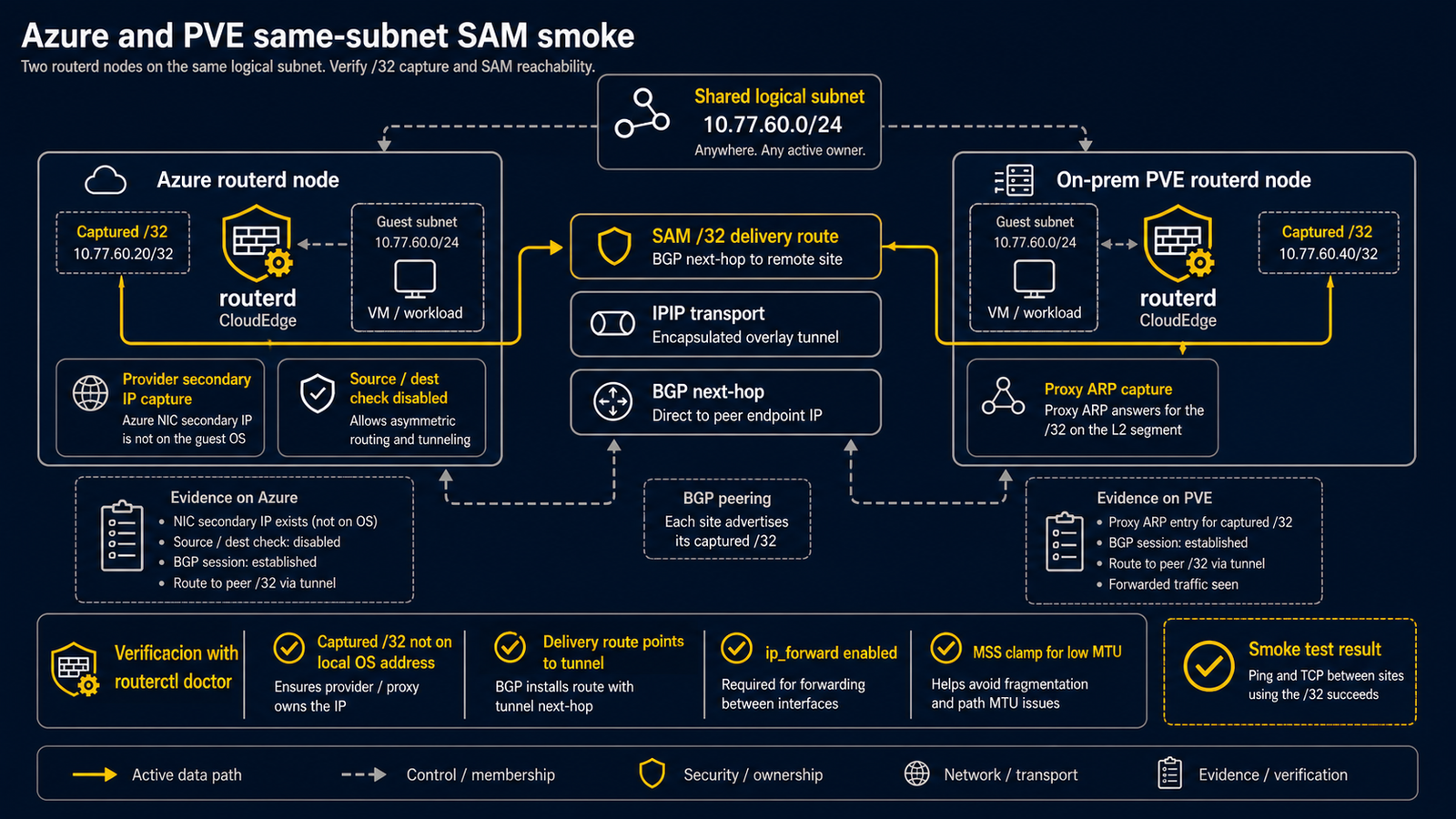
This guide captures the validated operational shape for an Azure routerd node
and an on-prem Proxmox VE routerd node that exchange selected /32 addresses
with Selective Address Mobility (SAM). See the
Selective Address Mobility reference
for resource semantics.
Azure side
- Keep the Azure NIC secondary IP assigned in Azure. That provider-side object
is what captures packets for the on-prem
/32. - Do not let the Ubuntu guest OS hold the captured
/32. cloud-init or netplan may auto-assign secondary NIC IPs; suppress that configuration or remove it. routerd enforces this during every BGP provider-secondary reconcile, even while Azure keeps the secondary IP assigned. The Azure NIC owns ingress, while Linux forwards by proxy-neighbor, forwarding sysctls/rules, and the imported/32route instead of a local/32address. - Enable IP forwarding on the Azure NIC and in Linux
(
net.ipv4.ip_forward=1).
On-Prem PVE Side
- Use
proxy-arpcapture on the LAN or bridge interface that sees the local same-subnet hosts. - Enable Linux forwarding. routerd enables
ip_forwardandproxy_arpfor SAM through the normal sysctl path. - Permit forwarding between the capture interface and the WireGuard tunnel for
the captured
/32. SAM does not add firewall or NAT rules. - On cloud guest images, also check host firewall defaults before assuming the
provider fabric is dropping packets. The router must accept the WireGuard UDP
listen port, and it must permit forwarding between the capture interface and
wg-hybrid.routerctl doctor hybridwarns on terminal iptables drop/reject patterns and missing SAM MSS clamp rules.
Tunnel And Routing
- WireGuard should dial from on-prem to the Azure public IP.
- Set
persistentKeepaliveon the on-prem peer so NAT and cloud edge state stay warm. - Run the initial smoke without UDRs. If you add UDR fallback later, avoid a
same-subnet loop where Azure routes the captured
/32back to the same router that is trying to deliver it. - Remote-owner
/32delivery comes from the BGP best-path import over the tunnel interface; it does not change the default route.
Verification
Run:
routerctl doctor hybrid
For provider-secondary-ip in BGP mode, confirm the doctor reports the
captured /32 absent from local ip addr, the delivery route points at the
tunnel, and ip_forward=1. For proxy-arp, confirm proxy_arp=1, the
proxy neighbor exists, the delivery route points at the tunnel, and
ip_forward=1.
For low-MTU overlays, confirm doctor hybrid reports a SAM MSS clamp and
nft list table inet routerd_mss contains both capture-to-tunnel and
tunnel-to-capture rules for the selected /32 path.