CloudEdge Mobility Demo
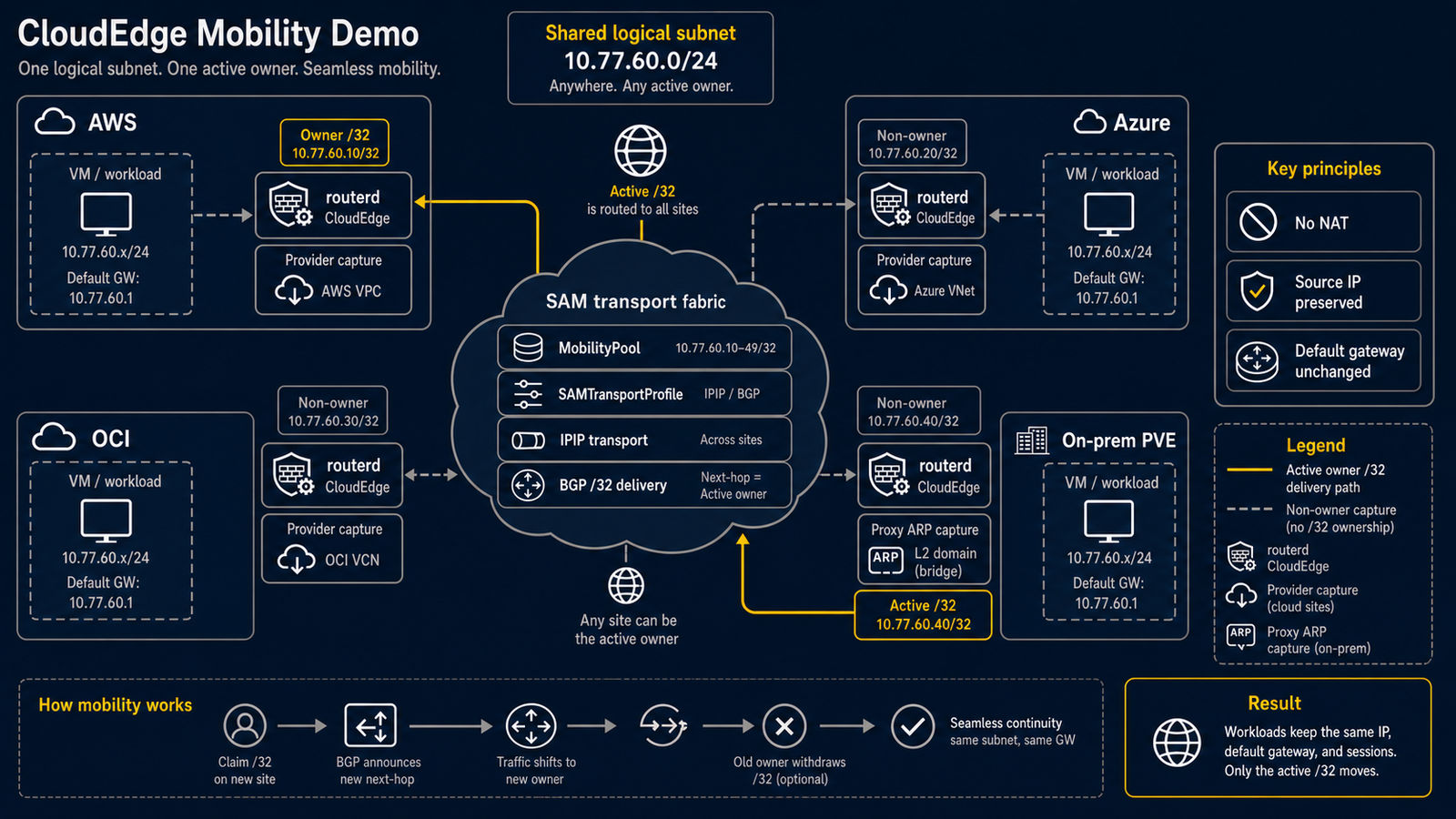
Experimental (CloudEdge). A lab demo of Selective Address Mobility (SAM): on-prem, AWS, Azure, and OCI share one logical
/24, and each site can serve an address that is owned by another site — without NAT and without changing the client's default gateway. The runnable package isexamples/cloudedge-mobility-demo/.
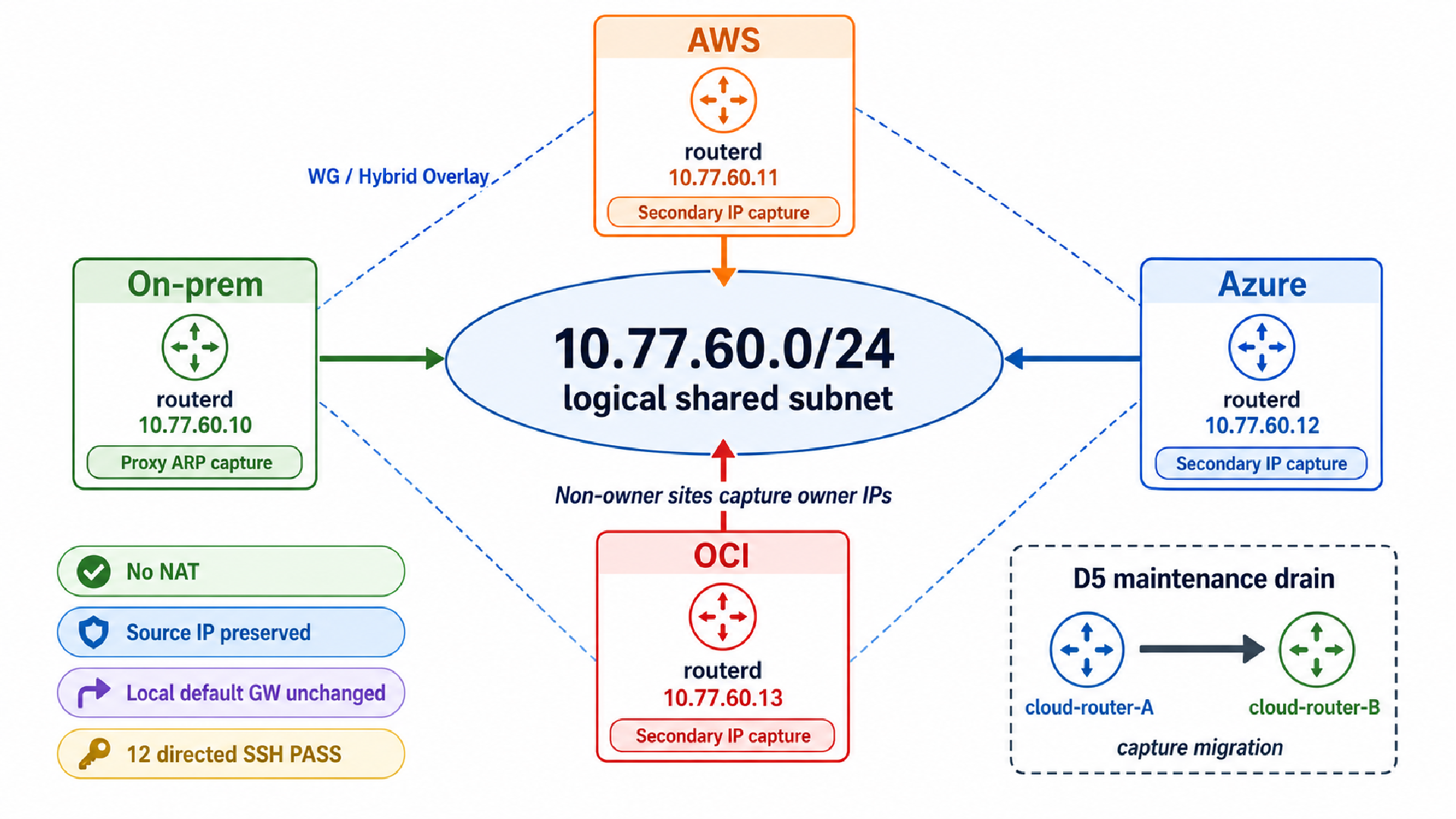
What this demo shows
- One logical
/24shared across four sites — on-prem / AWS / Azure / OCI all treat10.77.60.0/24as a single logical address space. - Non-owner sites capture the owner's address — each owner address is made reachable at every other site (cloud: provider secondary IP; on-prem: proxy ARP), arbitrated to a single owner.
- 12 directed SSH flows pass across the four demo clients.
- NAT-less, source-preserved, gateway-unchanged — connectivity keeps the real source IP, performs no NAT, and does not touch the client's default gateway.
- Cloud maintenance capture migration (D5) — a captured address moves from one cloud router to a standby in the same provider with traffic recovering through the new holder.
Address design
All four sites share one logical subnet; each site owns exactly one /32 within it.
| Site | routerd node | Owner address | Capture mechanism |
|---|---|---|---|
| On-prem | onprem-router | 10.77.60.10/32 | Proxy ARP on the LAN |
| AWS | aws-router-a | 10.77.60.11/32 | ENI secondary IP |
| Azure | azure-router | 10.77.60.12/32 | NIC secondary ipConfig |
| OCI | oci-router | 10.77.60.13/32 | VNIC secondary private IP |
Logical subnet: 10.77.60.0/24. The router-to-router transport uses a
separate RFC1918 endpoint/inner addressing plan (kept clear of link-local
169.254/16 and CGNAT 100.64/10); see
Selective Address Mobility for the
addressing constraints.
On the on-prem side, only 10.77.60.10/32 is declared with static ownership.
To discover additional on-prem clients, define ownershipDiscovery on the on-prem
member as mode: onprem-l2 and provide an arp-observer source on ens21.
Data plane
- provider-secondary-ip capture — on each cloud router, the owner addresses of the other sites are attached as secondary IPs on its ENI / NIC / VNIC, so the cloud fabric delivers them to that router.
- proxy-ARP capture — on-prem, the router answers ARP for the other sites' owner addresses on the LAN.
- BGP /32 delivery — each owner advertises its owned
/32; other routers import the best path and forward over the overlay to the owning site's router. - Generated SAM transport — routers interconnect through
SAMTransportProfile-derived IPIP tunnels and BGP peers. WireGuard, when enabled, is endpoint-only encryption underlay; itsAllowedIPscontain transport endpoint prefixes, not mobile/32s.
Because delivery is routed (not NAT'd), the source IP is preserved and the client's default gateway is unchanged.
Control plane
The operator declares only intent; everything else is derived.
- SAMNodeSet — the single shared identity/topology/placement registry for all seven routers.
- MobilityPool — the local address/capture intent. It imports that node set and retains only its self provider, capture, and discovery overlay.
- North-star member shape — each rendered config declares its own site
completely with
profiles.cloudCaptures,spec.values,targetFrom, andsubnetRefFrom; it does not repeat remote member entries or their provider NIC/subnet implementation details. - SAMTransportProfile — derives the per-peer
TunnelInterface, endpoint/32IPv4Route, andBGPPeerresources from a shared topology and inner prefix. - BGP /32 mobility paths — each owner advertises its owned host route; other sites learn the current best path over the generated SAM transport.
- Provider trap actions — cloud routers eventually assign/unassign remote owned /32s as secondary IPs for local trapping; these actions are no longer on the critical forwarding path.
- Event Federation —
routerd.client.ipv4.observedfacts propagate between sites (EventGroup/EventPeer/EventSubscription, see Event Federation). - Provider action executor — performs the gated cloud mutation (assign /
unassign secondary IP, forwarding) under
ProviderActionPolicy, using the instance's own cloud-native identity (see ADR 0007). - pathSig fencing — provider actions are fenced against the current BGP desired path signature and holder, so stale actions cannot mutate a route that has reconverged elsewhere.
The example configs use a shared SAMNodeSet and MobilityPool.membersFrom.
Each Pool retains exactly one local self overlay; remote identity, placement,
and maintenance stay in the node set. routerctl validate, plan, and apply
reject provider, capture, or discovery details on remote members.
How to run it
Use the package under examples/cloudedge-mobility-demo/. It assumes the lab
instances, NICs/VNICs, identity permissions, SSH, optional WireGuard endpoint
keys, and provider CLIs are already prepared — the scripts do not provision
cloud resources.
cd examples/cloudedge-mobility-demo
cp env.example env
$EDITOR env            # fill every placeholder; keep secrets out of git

./run-demo.sh          # render + deploy, emit events, run D3, then D5 migration
./collect-evidence.sh  # gather provider state, journals, and connectivity
./reset-lab.sh         # best-effort teardown; stops compute to avoid idle cost
Run reset-lab.sh after every run, even on failure.
Verified results
- D1 location auto-reflection: an owner address appearing on-prem is recognized by each cloud router.
- D2 cloud→on-prem capture (proxy ARP).
- D3 four-site 12 directed ping + SSH PASS — source preserved, no NAT, default gateway unchanged.
- D4 on-prem HA / VRRP capture failover.
- D5 cloud maintenance / capture migration PASS — drain
aws-router-a, the captured address moves toaws-router-b, traffic recovers via B; the stale pathSig action is fenced (skipped: stale mobility desired path). See the D5 evidence.
Caveats
- This is a lab demo, not a production turnkey.
- It is not full L2 extension / EVPN — there is no broadcast/multicast bridging.
- It is selective
/32address mobility: chosen addresses are made mobile across sites, not the whole subnet. - The scripts assume pre-provisioned instances and use placeholder, non-secret logical addresses; never commit real account/subscription/OCID/ENI/VNIC IDs or private keys.