Kubernetes API VIP with BGP
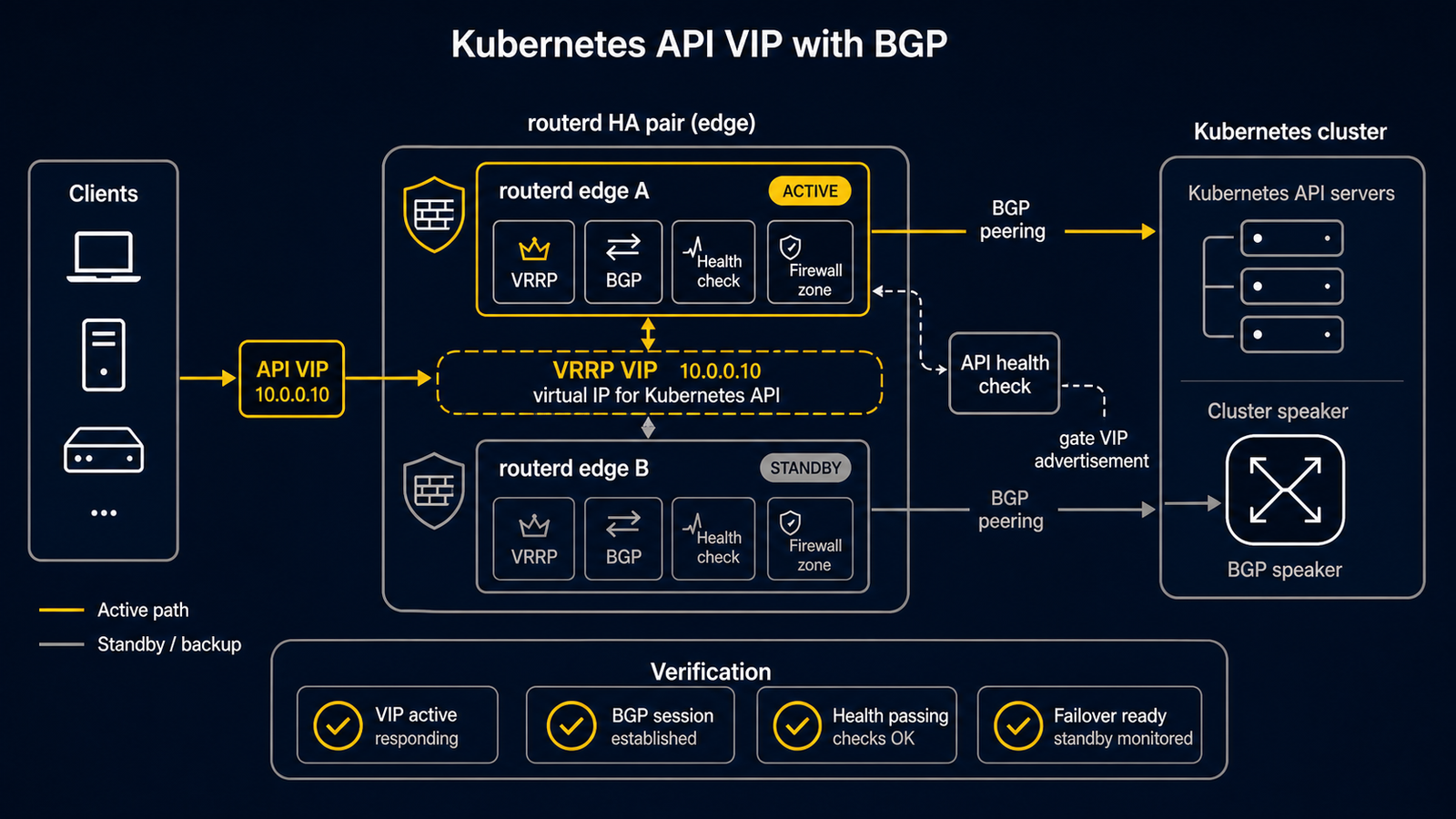
This example shows a routerd edge pair pattern for bootstrapping Kubernetes
without putting the API endpoint inside the cluster. The router owns a VRRP
VIP, forwards k8s-api.cluster.example:6443 to three control-plane backends, checks
/readyz over HTTPS, and peers with Kubernetes BGP speakers for Service
prefixes.
Use it only after a small lab router works. It is an end-to-end pattern with
multiple failure domains, not a first copy-and-paste configuration. Validate
and dry-run it before a daemon exists. First replace the interface names, VIP
and peer addresses, backend names, and BGP peers with values from your lab.
The supplied *.cluster.example backend names are placeholders, so validation
can succeed while the dry-run correctly stops until those names resolve:
routerd validate --config examples/kubernetes-api-vip.yaml

workdir=$(mktemp -d)
routerd apply --config examples/kubernetes-api-vip.yaml --once --dry-run \
  --state-file "$workdir/state.db" \
  --ledger-file "$workdir/ledger.db" \
  --status-file "$workdir/status.json"
rm -rf "$workdir"
Topology:
routerd-01/02  VRRP VIP 192.168.70.10
       |
       +-- k8s-cp-01..03 :6443  HTTPS /readyz
       |
       +-- k8s-wk-01..04  BGP ASN 64513
The important production-oriented settings are:
| Resource | Setting |
|---|---|
VirtualAddress/k8s-api-vip | VRRP preempt settings and track entries for API health and BGP health. |
IngressService/kubernetes-api | HTTPS health check on /readyz, tlsSkipVerify: true for kubeadm self-signed bootstrap certs, failover selection, reject on no healthy backend, and automatic same-interface hairpin SNAT when selected control-plane backends are on the VIP LAN prefix or the same private /24. |
BGPRouter/lan | convergenceProfile: fast, BGP timers 3s/9s/5s, graceful restart disabled by default, and an import allow-list for Kubernetes Service prefixes only. |
DNSResolver/lan | Automatically serves k8s-api.cluster.example from the VIP hostname field, plus static control-plane and worker records. |
Keep the DHCP pool away from the VIP, control-plane addresses, worker addresses, and LoadBalancer/Service advertisement ranges.
For operations, routerctl get BGPRouter, routerctl get VirtualAddress, and
routerctl get IngressService provide table views for peer state, VIP role, and
backend health without dumping raw status JSON. Inspect host ip, nft, and
conntrack state directly when debugging live dataplane behavior.