Multi-WAN IPv4 failover
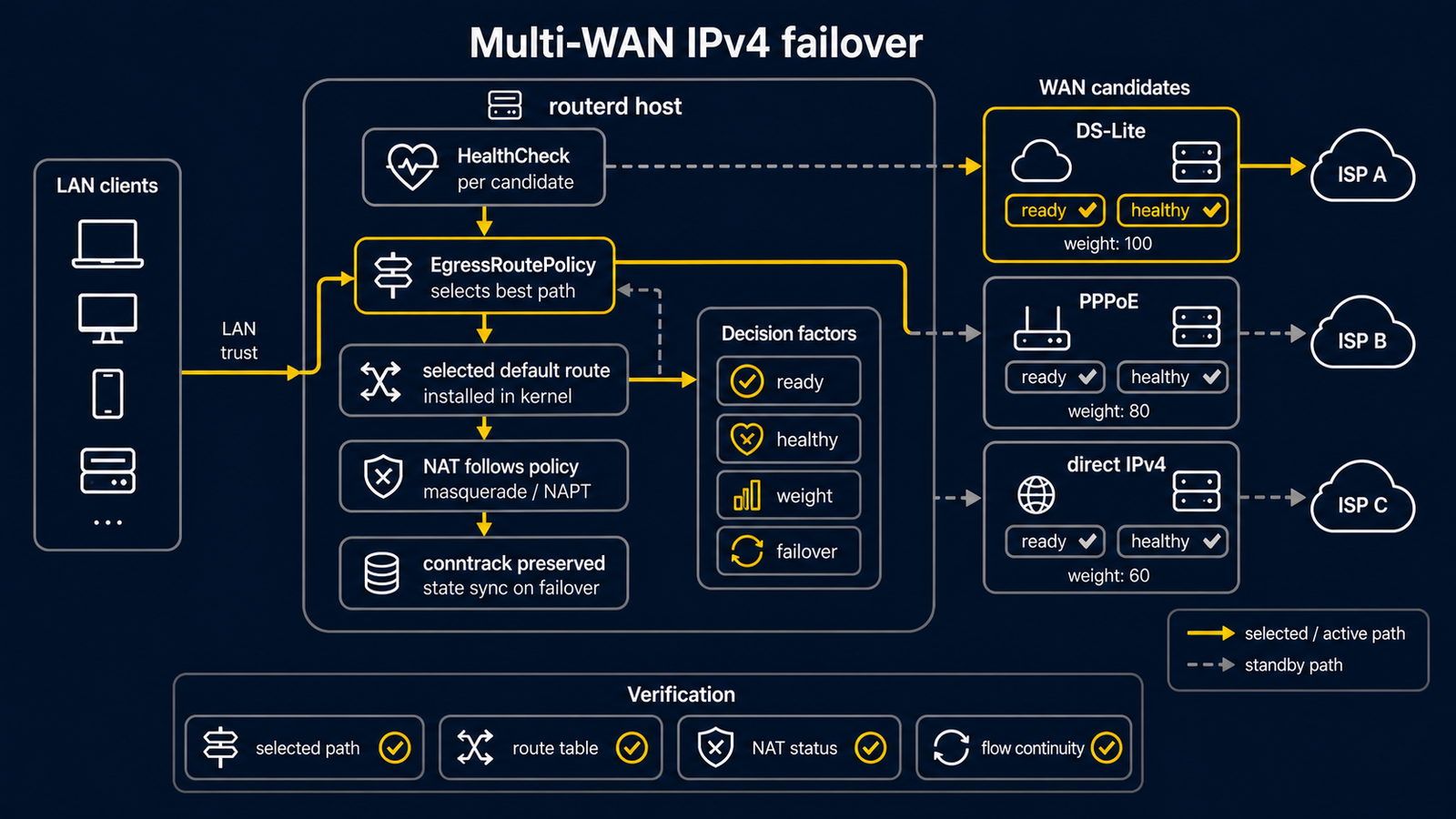
This example selects one IPv4 default route from two DS-Lite tunnels and a direct upstream-router IPv4 fallback. It does not configure PPPoE.
The complete, validated YAML is in examples/multi-wan-home.yaml.
Topology
Diagram map
| No. | Meaning | Main resources |
|---|---|---|
| [1] | Physical access line used by all WAN candidates. | Interface/wan, DHCPv4Client/wan-dhcpv4 |
| [2] | Router selecting one default route. | EgressRoutePolicy/ipv4-default |
| [3] | Primary DS-Lite candidate. | DSLiteTunnel/ds-lite-a, HealthCheck/internet-a |
| [4] | Additional DS-Lite candidate. | DSLiteTunnel/ds-lite-b, HealthCheck/internet-b |
| [5] | Direct upstream-router IPv4 fallback. | DHCPv4Client/wan-dhcpv4 |
| [6] | LAN clients using the selected egress path through NAT. | NAT44Rule/lan-to-selected-wan |
What this manages
| Area | routerd resources |
|---|---|
| Egress paths | DSLiteTunnel/*, DHCPv4Client/wan-dhcpv4 |
| Link readiness | HealthCheck/internet-a, HealthCheck/internet-b |
| Selection | EgressRoutePolicy/ipv4-default |
| Default route | Derived by EgressRoutePolicy/ipv4-default |
| NAT | NAT44Rule/lan-to-selected-wan |
Key config
# [2] Choose the highest-weight candidate that is currently healthy.
- kind: EgressRoutePolicy
  metadata:
    name: ipv4-default
  spec:
    family: ipv4
    destinationCIDRs:
      - 0.0.0.0/0
    selection: highest-weight-ready
    candidates:
      # [3] Primary DS-Lite candidate.
      - name: ds-lite-a
        deviceFrom:
          resource: DSLiteTunnel/ds-lite-a
          field: device
        gatewaySource: none
        weight: 100
        healthCheck: internet-a
      # [4] Second DS-Lite candidate.
      - name: ds-lite-b
        deviceFrom:
          resource: DSLiteTunnel/ds-lite-b
          field: device
        gatewaySource: none
        weight: 80
        healthCheck: internet-b
      # [5] Direct HGW route is the last fallback in this example.
      - name: hgw-direct
        deviceFrom:
          resource: Interface/wan
          field: ifname
        gatewaySource: dhcpv4
        gatewayFrom:
          resource: DHCPv4Client/wan-dhcpv4
          field: gateway
        weight: 40
Checks
sudo routerd validate --config examples/multi-wan-home.yaml

workdir=$(mktemp -d)
sudo routerd apply --config examples/multi-wan-home.yaml --once --dry-run --skip-service-manager \
  --state-file "$workdir/state.db" \
  --ledger-file "$workdir/ledger.db" \
  --status-file "$workdir/status.json"
rm -rf "$workdir"
After the service is running, inspect sudo routerctl describe EgressRoutePolicy/ipv4-default and ip route show default. The policy
controller owns the selected route; this example does not declare an
IPv4Route/default resource.
Operational notes
- Keep health checks conservative. Very short intervals can make a weak link flap.
- This exact example has no
hysteresisvalue. Add one only after checking the current API documentation and observing a real flap you need to dampen. - Keep RFC1918 destinations excluded from NAT and policy routing unless you really want to NAT private routed networks.